One Dead in Shooting at Luke AFB  


GLENDALE, Ariz. - Authorities say two men were shot by security officers after they drove a stolen car through a gate at an Air Force base outside Phoenix during a police chase.

Officials say one of the men died and the other was wounded.

The crash occurred at the entrance to Luke Air Force Base in Glendale, outside Phoenix. The base trains pilots to fly F-16s.

Base spokesman Capt. Jerry Gonzalez said the pair allegedly stole a car and drove through a security gate as they attempted to flee from authorities.

Gonzalez said base security forces set up a roadblock. As the driver tried to run it, security officers fearing for their safety opened fire.

AddThis Social Bookmark Button
Email this post


VA Secretary Outlines Goals for Vets  

FORT BLISS, Texas - More than 50 veterans gathered to hear Secretary of Veterans Affairs Eric K. Shinseki speak about his goals to improve the quality of life for veterans at the El Paso VA Health Care System facility.

Shinseki, who is a member of President Obama's cabinet, was hosted by three local members of Congress, including Rep. Silvestre Reyes, Rep. Ciro Rodriguez and Rep. Harry Teague.

During Shinseki's visit, he toured the VA facility and the Fort Bliss National Cemetery, and he participated in a veterans roundtable before addressing the public on the purpose of his visit.

In his speech, he addressed three specific goals targeting programs affecting the nation's veterans: reducing the growing backlog of claims, improving the quality of VA healthcare facilities and reducing homelessness among all veterans.

Teague agreed that "there is a definite culture change happening within the area of veterans affairs."

Regarding the backlog, Shinseki has established four pilot projects: one in Pittsburgh; others in Little Rock, Ark.; Providence, R.I.; and Baltimore that will help the department identify how to simplify claims and minimize obstacles that keep veterans from registering with the VA.

As for the second goal, he shared that the 2011 budget, while under review, includes a financial increase for the Veterans Benefits Administration, which will allow for more medical personnel and better facilities.

Even though more than 131,000 veterans are homeless, Shinseki stressed he won't be able to take them all off of the street; rather, he spoke of the importance of opening up jobs and enhancing education for veterans, using new programming and funding, such as the GI Bill.

Shinseki said the Obama administration is planning to increase the Veteran Affairs budget by 15 percent in 2010, which is the largest increase in more than 20 years.

As for Shinseki's goals, Teague and the other congressmen said they have absolute confidence in his leadership and that he will accomplish all he can during his term.

"He openly addresses the hurdles we face in the VA," Teague said. "He's not trying to sweep them under the carpet."

AddThis Social Bookmark Button
Email this post


Laser Weapon Knocks Down Missile  


LOS ANGELES - A high-powered laser destroyed a target missile in flight off the Central California coast in a milestone test of a futuristic but troubled national defense system, the Air Force announced Friday. 

A laser weapon mounted on a Boeing jumbo jet tracked the missile as it accelerated over the ocean off the Point Mugu Naval Warfare Center Thursday night, then fired an energy beam that heated the missile until it cracked and broke up, according to statements from the Air Force and two aerospace companies involved in the program. 

The test is a boost for a program that has had billions in cost overruns and saw its budget sharply cut last year by Defense Secretary Robert Gates, who called the concept "fatally flawed" and destined if for minimal research-and-development.

While the success of the test is a technological triumph, it won't save the airborne laser program from being placed on life-support, a defense analyst said.

"The program results are, unfortunately, two years behind the secretary's decision to cancel the program," said Jim McAleese of Mcaleese and Associates, a lawyer and defense consultant in Virginia who is not affiliated with the project.

The laser program was designed to kill missiles at short range. The 2011 budget for the Missile Defense Agency concentrates instead on two ship-based missiles - the Aegis and the SM-3 - that are more useful for regional conflicts involving, say, Iran or North Korea, Mcaleese said.

"As a practical matter, absent something extraordinary, the program has already receded backwards into a technology incubator as opposed to proceeding into production and fielding," he said.

During Thursday's test, the so-called Airborne Laser Testbed was flown on a modified Boeing 747-400F that took off from Edwards Air Force Base in the Mojave Desert, Boeing said.

The system used two low-energy lasers to target the missile as it was boosting into the sky from a sea platform, then fired a megawatt-class Chemical Oxygen Iodine Laser, or COIL, according to the Air Force and the Missile Defense Agency.
"While ballistic missiles like the one ALTB destroyed move at speeds of about 4,000 miles per hour, they are no match for a superheated, high-energy laser beam racing towards it at 670 million mph," Northrop Grumman Corp. said in a statement. "The basketball-sized beam was focused on the foreign military asset, as the missile is called officially, for only a few seconds before a stress fracture developed, causing the target to catastrophically split into multiple pieces."

"This experiment marks the first time a laser weapon has engaged and destroyed an in-flight ballistic missile, and the first time that any system has accomplished it in the missile's boost phase of flight," Boeing Co. said in a statement. "ALTB has the highest-energy laser ever fired from an aircraft, and is the most powerful mobile laser device in the world."

However, the Air Force said the weapon destroyed a solid-fuel target missile in flight on Feb. 3, although the statement did not provide details. It said the same kind of solid-fuel missile was hit by the laser in a second test Thursday night at Point Mugu but the beam shut off before it could destroy the rocket, the Air Force said.
Much of the research on the program was done in Southern California, which would have benefited economically had the program gone operational.

The airborne laser program began in 1996 and is one in a series of missile defense programs that originated in President Ronald Reagan's Strategic Defense Initiative in 1983 - the much-maligned "Star Wars" missile shoot-down effort that was criticized as impractical, expensive and overreaching.

The airborne laser program itself was years behind schedule and billions of dollars over budget when the defense secretary decided to cancel money for a second aircraft and opted to shunt the existing weapon into research and development.

"This was supposed to put high-powered lasers on a fleet of 747s," Gates said in a speech last year. "After more than a decade of research and development, we have yet to achieve a laser with enough power to knock down a missile in boost phase more than 50 miles from the launch pad - thus requiring these huge planes to loiter deep in enemy air space to have a feasible shot at a direct hit."

Gates said the program would have needed 10 to 20 operational aircraft at around $1.5 billion each. 


AddThis Social Bookmark Button
Email this post


What's In Store for Military Homeowners?  

Nationally, 2010 promises more opportunity for buyers and a far improved year for sellers. Buyers will continue to see very favorable home prices, historically low interest rates, and the extended tax credit for first time buyers, and many repeat buyers. 

And for sellers, although we’re still years from a full recovery of prices, inventory declined with the increased buyer activity, which clearly stabilized home prices and in some cases, resulted in appreciation. This reduced inventory also means a more balanced negotiation on the prices, too. In many areas, there are still a considerable number of future foreclosures that will slow recovery, but it should be better than 2008 and 2009. 

But, the Fed announced the end to the Debt Purchase Program on April 1, 2010 with a clear hint that interest rates will jump immediately by ¾ percent. This could increase the monthly payments for buyers and could slow home sales. 

In a much needed reform, the new New Real Estate Settlement Procedures Act (RESPA) rules -- effective Jan.1, 2010 -- will provide more clarity and transparency in the loan process. Essentially, what the lender offers in the Good Faith Estimate (GFE) must match, with few exceptions, the actual settlement charges on the HUD 1 final settlement accounting form. We expect the learning curve and variations in interpretation by settlement companies and lenders to initially cause disruption in the process. 

Here’s a heads up on how this new procedure can really throw a wrench in the process:

Certain changes to the GFE can trigger a mandatory, non-waiverable, three-day disclosure period during which settlement can’t take place. For instance, if a buyer locks-in the interest rate a few days before settlement, the settlement could be postponed past the original settlement date. This could be very ugly with the movers sitting in the driveway of your new home and it could cost the buyers more than extra pizza! This could snowball to a major problem for the seller who may need the proceeds from the sale to settle on their new home. Litigation comes to mind. 
VR SAM® strongly encourages buyers in the first half of 2010 to plan their household goods shipment / move in for several days after settlement. Hey, it will give you time to paint. Likewise, we strongly encourage sellers to plan a subsequent settlement on their new home for several days after the settlement date on their existing home to allow for unanticipated glitches and settlement delays in the new process.

Regarding the extended tax credit, a credit for repeat home buyers (certain restrictions apply) of $6,500 was added to the first-time home purchasers’ credit of $8,000. To get the credit, you must be under ratified contract by April 30 and settled by June 30, 2010. Be certain that this will create a backlog for both lenders and settlement companies as these dates approach, so the old early bird approach may benefit your bank account.

I have a friend who “bought smart and held” three homes throughout his 30-year Navy career. During that time he rented these homes to other military families who of course have an excellent reputation as responsible tenants. Now in retirement, he enjoys a very sizeable passive income from these rentals that are now mortgage free. Yes, I know that everyone is gun shy from the debacle of the past three years. But, when the “herd” is running in one direction, stop to consider the contrarian perspective. Is this a good time to buy smart and hold?

AddThis Social Bookmark Button
Email this post


VA Eyes $125B Budget for 2011  

 
The Veterans Administration is pushing for expanded rural health care for veterans, increased funding and attention to female veterans' health needs and ending veterans' homelessness as part of a $125 billion budget proposed by the White House for fiscal 2011. The budget also includes funds to be used for speeding up the processing of disability compensation claims and completing the automation of GI Bill applications.

"Our budget proposal provides the resources necessary to continue our aggressive pursuit of President Obama's two over-arching goals for veterans," Secretary of Veterans Affairs Eric Shinseki said yesterday in a statement. "First, the requested budget will help transform VA into a 21st century organization. And second it will ensure that we approach veterans' care as a lifetime initiative, from the day they take their oaths until the day they are laid to rest."

To speed up disability claims, the White House is proposing boosting processors by more than 4,000. The VA received 1,014,000 claims in 2009 and anticipates 1,319,000 in 2011, in part because of the agency's expansion of the number of diseases now automatically attributed to exposure to Agent Orange during the Vietnam War, according to the VA.

The budget, an $11 billion increase over the current year's, includes $60.3 billion in discretionary spending, mostly health care, and $64.7 billion for entitlements, largely disability compensation and pension, the VA said.


Also included in the budget is $44 million to complete an automated system for processing applications for the Post-9/11 GI Bill. Spokeswoman Katie Roberts told Military.com Monday that the project is on target to be finished by December.

One of the biggest items in the budget is $4.2 billion to eliminate and help reduce homelessness among veterans. The figure includes $3.4 billion for core medical services and $799 million for specific homeless programs and expanded medical care, according to the VA, which says that 131,000 vets are homeless on a typical night.

In addition, the proposed 2011 budget includes $5.2 billion for mental health care and suicide prevention, a $410 million increase over the current year's appropriation that would be used to expand inpatient, residential and outpatient mental health services. The plan also calls for making mental health services part of primary care and specialty care. The VA said in a statement that the money will permit the continued expansion of programs for post-traumatic stress disorder and traumatic brain injury, and for diagnosing and treating mental health problems and preventing suicides.

Among veterans eyed for expanded care under the 2011 budget are those living in rural America and women.
The budget includes $250 million to beef up health care access to an estimated 3.2 million vets living in rural areas. Some of the money will go toward expanded use of home-based primary care and mental health services, but it will also include an additional $42 million for the VA's "telehealth" program, which permits health care providers to monitor patients daily via phone and telephone-based data transmission. Currently the VA has 35,000 vets in the telehealth program.

With the number of female veterans growing rapidly and many turning to the VA for health care, the agency intends to appropriate $217.6 million to meet the medical needs of women. This is $18.6 million more than is currently being spent on women-specific health programs.

AddThis Social Bookmark Button
Email this post


IN HONOR : Last WWI Vet Turns 109  

Last U.S. veteran of World War I turns 109

Courtesy: Paul Courson, CNN

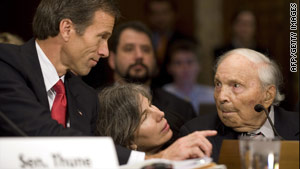
Sen. John Thune of South Dakota helps Frank Buckles, right, speak before a Senate subcommittee.

Washington (CNN) -- The last surviving U.S. veteran of World War I, former Cpl. Frank Buckles, turns 109 on Monday and is still hoping for a national memorial in Washington for his comrades.

Buckles is expected to deliver remarks during a quiet celebration Monday afternoon at his home in Charles Town, West Virginia.

But the old "Doughboy" -- as World War I American infantry troops were called -- has already been outspoken in recent years, urging congressional lawmakers to give federal recognition and a facelift to a run-down District of Columbia memorial in an overgrown, wooded area along the National Mall.

In December, at 108, Buckles testified on Capitol Hill as lawmakers considered whether to fund renovation and give the site "national" monument status. But rival legislation seeks the "national" designation for a 1920s-era memorial located in Kansas City, Missouri.

Congress has not yet decided on the legislation.

In 2008, the old soldier came to Washington and visited that 1930s-vintage District memorial. In his wheelchair, helped along by a military aide, he slowly crossed the cracks in the flagstone walkway, and saw the cracks in the marble gazebo.

Still sharp at only 107, he noted during that visit that the names engraved along the gazebo's marble walls are only of those who hailed from District of Columbia.

Buckles that day also met with then-President George W. Bush at the White House and Defense Secretary Robert Gates at the Pentagon.

Later in 2008, Buckles was the guest of honor at Veterans Day ceremonies at Arlington National Cemetery. He said he considers it his duty to represent his fellow soldiers.

 
Oldest WWI Vet : Frank Buckles

"I have to," he told CNN, "because I'm the last living member of Americans," who fought in what was called The Great War.

As a soldier in the U.S. Army, Buckles was an ambulance driver for U.S. forces in Europe, and once met commanding Gen. John Pershing, near whose grave the more recent Veterans Day ceremony was held.

Buckles was warmly greeted with standing applause by those in uniform and others who had gathered for the commemoration, but he said he did not think the fuss was about him.

"I can see what they're honoring: The veterans of World War I."

"Time has passed very quickly to me," he told CNN after a wreath-laying, "I've had a lot of activity in the last 90 years."

AddThis Social Bookmark Button
Email this post


Former Officer Sentenced in Spy Case  


ALEXANDRIA, Va. - A former Pentagon official has been sentenced to three years in prison for espionage after being convicted of giving classified information to a Chinese spy.

The sentence handed down Friday was significantly less than the 6 1/2 years sought by prosecutors for 62-year-old James Fondren of Annandale, a former Air Force officer.

U.S. District Judge Claude Hilton said a lighter sentence is warranted because the information disclosed by Fondren caused little or no harm to U.S. national security.

Fondren was convicted of giving classified information on U.S.-China military relations to a friend who turned out to be a spy for China.

Fondren was convicted on only three of the eight counts prosecutors brought to trial. He is appealing his conviction.

AddThis Social Bookmark Button
Email this post


Pilot Missing From Vietnam War Found  


Officials with the Department of Defense POW/Missing Personnel Office announced that the remains of an Air Force pilot, missing in action from the Vietnam War, have been identified and will be returned to his family for burial.

Maj. Russell C. Goodman of Salt Lake City, Utah, will be honored at Nellis Air Force Base, Nev., home of the U.S. Air Force Thunderbird demonstration team. At the time he was lost, Major Goodman was assigned to the Thunderbirds and was flying with the U.S. Navy on an exchange program. He will be buried in Alaska at a date determined by his family.

On Feb. 20, 1967, Major Goodman and Navy Lt. Gary L. Thornton took off in their F-4B Phantom from the USS Enterprise for a bombing mission against a railroad yard in Thanh Hoa Province, North Vietnam. They were struck by enemy antiaircraft fire and their plane exploded. Lieutenant Thornton was able to eject at just 250 feet altitude, but Major Goodman did not escape. Lieutenant Thornton survived and was held captive until his release in 1973.

Search and rescue attempts were curtailed because of heavy anti-aircraft and automatic weapons fire in the area of the crash.

Between October 1993 and March 2008, joint U.S.-Vietnamese teams led by the Joint POW/MIA Accounting Command investigated the crash site twice and conducted two excavations, recovering human remains and pilot equipment. The aircraft debris recovered correlates with the type of aircraft the men were flying.

Among other forensic identification tools and circumstantial evidence, scientists from JPAC and the Armed Forces DNA Identification Laboratory also used mitochondrial DNA, which matched two of his maternal relatives, in the identification of Goodman's remains.

AddThis Social Bookmark Button
Email this post


Radio-controlled C5  


AddThis Social Bookmark Button
Email this post


C-17 Rolling Down the Strip  

"Anytime, Anyplace!"


AddThis Social Bookmark Button
Email this post


Report Finds 75 Percent of Young Americans Unfit For Military  


It is not a short term problem because high unemployment rates are causing many qualified people to join the military. But retired generals and admirals say if the problem continues, national security could be in jeopardy when the economy improves.

Staff Sgt. Terrence Pugh's isn't fighting in a war zone. But on this college campus, his mission is anything but easy. Pugh is looking for new Army recruits. He says many people consider the military when they have no other options.

"Most people are not really interested in joining any branch of service really until life gets them in a bind," he said.

Vernika Givens is a single mom and unemployed. The Army offered Givens and her daughter a future.
"Medical benefits, a steady paycheck. I can get college money and I can save some money for her when she gets older," Givens said.

Givens is one of only a small group of Americans who qualify for the military.
 

The Army says seven out of 10 people who apply cannot pass a reading and math test.
A report released by Mission Readiness, an organization of retired military leaders, finds 75 percent of young Americans between 17 and 24 are unfit for the military.

The reasons: they did not graduate from high school, have a criminal background or are physically overweight and out of shape.

Mission Readiness says the military is currently meeting if not exceeding its recruitment goals largely because of the economic downturn. But many retired generals fear that there may be a shortage of qualified recruits when the economy improves.

"Our national security in the year 2030 is absolutely dependent on what's happening in pre-kindergarten today," Retired Navy Rear Admiral Jamie Barnett said.


Barnett says research shows children enrolled in a quality pre-kindergarten program raises their high school graduation rate by 44 percent.

"Those are the most sensitive years of their life, the years when you can really get them socially, emotionally, physically, any skill you want with them to make them a child who can succeed," Ricky Gleen said.

Gleen teaches at an early childhood development school called Centro Nia in Washington. He says students drop out of school and get in trouble with the law because they lack problem solving skills and self-esteem.

The Mission Readiness report finds students who do not get a quality early childhood education are 70 percent more likely to be arrested for a violent crime by the time they turn 18.

Gleen says every activity here teaches skills to help students make better life choices.

"They have a sense of self. They have a sense they can make it. They have a sense that they can solve problems," he said.

Gleen's school also teaches students the value of education, how to eat right and exercise.

The goal is that they can continue to apply what they have learned here when they get older.

Some of them may even decide to join a high school Junior Reserve Officers Training Corps class like this one.

"I really like the sense of team and leadership and friendship," Jamie Whitaker said.

Whitaker has good grades, is on a swim team and plans to join the U.S. Air Force.

The military wants to see more possible recruits like Whitaker. And the retired military leaders with Mission Readiness are pushing Congress for one billion dollars a year for up to 10 years to fund more early childhood development programs.

"It is a long term investment," Arne Duncan said. "It is not something that pays off overnight. It is absolutely the right investment we can make."

Duncan is the Secretary of Education. He adds, if nothing is done, America's national security will be at risk.


AddThis Social Bookmark Button
Email this post


F-22s complete first Middle East deployment  

12/21/2009 - SOUTHWEST ASIA (AFNS) -- Airmen completed the first deployment of F-22 Raptors to the Middle East in mid-December.

The fifth-generation fighters and their crews were in the area as part of a multinational exercise where pilots from a variety of nations train together in fighting a large-scale air war.

This was the first deployment to the U.S. Air Forces Central area of responsibility for the 150 Airmen deployed from Langley Air Force Base, Va., and the six F-22s they operated.

"We didn't know how the jet was going to perform or react, given the temperature differences as well as the dust, sand and wind," said Lt. Col. Lance Pilch, the 27th Expeditionary Fighter Squadron commander. "But we were able to fly more sorties than we scheduled for, so the F-22 actually exceeded expectations."

The F-22 previously deployed to Kadena Air Base, Japan, and Andersen Air Force Base, Guam, for exercises in the Pacific.

"This was historic because it's a new weapon system, and although we had shown we can deploy to other places, we hadn't proven we could operate here," said Maj. Daniel Bunts, a member of the Virginia Air National Guard who flies F-22s with the 27th Fighter Squadron.

In addition to the U.S., exercise participants included aircrews from France, Jordan, Pakistan and England.
Although the F-22s weren't participating directly in the exercise, they flew alongside crews from the participating nations in training sorties.

"Now that we've done some training together, they have a better understanding of what we can do with this jet, so if we ever need to partner together, they know what they can expect from us as their wingmen," Major Bunts said. "But it's also important for us to put a face to the weapon system for our partners. We've made great friends out here."

Building partnerships is largely what exercises like this are all about. But now that the F-22 has proven capable in the environment here, the crews hope to return to participate in more exercises, and even provide airpower in the region, Colonel Pilch said.

"The F-22 has so many capabilities, from overall air dominance to relaying situational awareness to putting bombs on target," Colonel Pilch said. "So when it becomes our turn to come here and support the troops on the ground, now we know: the Raptor is ready."


AddThis Social Bookmark Button
Email this post


Hurricane Hunters fly first winter storm  

12/21/2009 - KEESLER AIR FORCE BASE, Miss. (AFNS) -- Members of the 53rd Weather


Reconnaissance Squadron here have been tasked by National Weather Service officials to fly their first winter storm of the season on the East Coast starting Dec. 25.

The Air Force Reserve's 53rd WRS "Hurricane Hunters," assigned to the 403rd Wing here, normally collect weather data during tropical storms, enabling forecasters to make more accurate predictions.

Between hurricane seasons, the Hurricane Hunters have a lesser known, but equally important role: collecting weather data during winter storms.

"Whenever there's a system track that will cause an impact, there's potential for winter storms," said Lt. Col. Jon Talbot, a 53rd WRS aerial reconnaissance weather officer since 1992.

To prepare for a winter storm flying mission, the Hurricane Hunters carefully plan the mission, review which flying route they will take and make altitude reservations by coordinating with air traffic control, said Lt. Col. Roy Deatherage, a 53rd WRS aerial reconnaissance weather officer.

"The National Weather Service runs computer models that forecast the weather three to five days in advance of a storm," Colonel Talbot said. As an aerial reconnaissance weather officer, he acts as a mission director and liaison between the National Weather Service and his crew.

"Winter storms have a lot of impact," he said, detailing the emergency services and salt trucks that are used once the threat of a winter storm has been confirmed.

The Hurricane Hunters have two winter storm missions, Colonel Talbot said. The first is the Pacific mission. 

"We average 20 missions over 30 days when we deploy our airplanes to either Alaska or Hawaii." The second is flying winter storms locally in the Gulf of Mexico and in the Atlantic Ocean.

"The goal is to improve the weather forecast for the East Coast because we have a lot of people and money tied up in the Washington to Boston corridor," Colonel Talbot said.

The return of investment for flying winter storms and collecting data is an estimated 15 percent greater accuracy in weather forecasting.

"There are some 5,000 salt trucks in New York City alone," Colonel Talbot said. The increase in forecasting accuracy directly impacts emergency management capabilities by reducing the unnecessary dispatch of resources, which can be costly.

"If you collect the right information at the right place -- over the Pacific Ocean -- you can make a big impact to the forecast four to five days later," Colonel Talbot said. The idea is to fly winter storms before they happen to make the forecast better for the entire Northeastern community.

Colder weather at high altitudes presents a unique challenge to the Hurricane Hunters since the crew must remain cognizant of icing, said Maj. Kevin Fryar, a 53rd WRS aerial reconnaissance weather officer.

The Hurricane Hunters fly WC-130Js at high altitudes, typically 5 to 10,000 feet above their normal range, and drop small weather canisters, or dropsondes, designed to collect weather data in key locations of high-weather activity.

Weather information collected from the dropsondes is then transmitted to the National Weather Service and is ultimately used by forecasters to assess weather patterns enabling them to forecast more accurately.
In a storm, data is transmitted to the National Weather Agency and is later passed on to the Air Force Weather Network, Colonel Talbot said.

"When you fly a hurricane mission, you know you're making a difference," Colonel Talbot said. "With this mission, we know there are people waiting for the information we give to make the best possible forecast. It's essentially the same thing (as a hurricane mission)."

To Colonel Talbot, a 24-year veteran to the weather field, the experience is as rewarding as it is beneficial.
"What other meteorologists get to fly? You get the best of both worlds." he said.

To the people waiting for the forecast, the information he collects can mean the difference between spending 
hundreds of thousands in preparing for the weather rather than millions of dollars reacting to it.


AddThis Social Bookmark Button
Email this post


Raptors complete first deployment to southwest Asia  

LANGLEY AIR FORCE BASE, Va. — Completing another milestone in F-22A Raptor history, 27th Fighter Squadron aircraft and personnel returned from southwest Asia Dec. 16 after six raptors and squadron support personnel were deployed to the region for a 40-day multi-national training exercise.

This was the fifth-generation aircraft’s first deployment to southwest Asia, where 27th FS and coalition partners engaged in simulated air-to-air combat while training in an arid environment. The Air Force is meeting its on-going commitments and security obligations by maintaining a flexible and credible presence in southwest Asia.

The first real-world deployment for America’s newest fighter jet was in 2007 to Kadena Air Base, Japan, soon after obtaining full-operational capability. In 2008, the Raptor completed its first trans-Atlantic deployment to participate in the 2008 Royal International Air Tattoo and the Farnborough International air show.

AddThis Social Bookmark Button
Email this post


Copyright © 2010 | The Military Post | All Rights Reserved