CROWS Surge to Afghanistan With GIs  


PICATINNY ARSENAL, N.J. - With the surge to Afghanistan now underway, thousands of XM-153 Common Remotely Operated Weapons Stations, known as CROWS, will soon be taking flight to strengthen U.S. Army forces in theater.

Program Executive Office Soldier is ramping up its stateside logistics efforts and is in the process of establishing three new CROWS support sites in Afghanistan. The sites -- under PEO Soldier 's Project Manager for Soldier Weapons -- will manage the fielding, training, and sustainment of the XM-153 CROWS.

The CROWS systems mount what is essentially a small turret on top of Army combat vehicles that provides Soldiers the ability to employ their machine guns while using a control grip and video monitor from inside the protection of an armored vehicle. There are currently about 1,000 CROWS systems already in use in Iraq and Afghanistan.

"We are embedding the new CROWS support sites with units that are farther afield to enhance our support of the warfighter," said Lt. Col. Michael Ascura, product manager for crew-served weapons. "We fielded one new site in December and will bring two more online by April in Afghanistan."

The complexity of the fielding is magnified by the sheer number of military vehicles and vehicle variants that are now employing CROWS; including MRAPS, Humvees, route clearance vehicles, the new MRAP All-Terrain Vehicles or MATVs, and others.

Each vehicle requires customized vehicle integration kits to bring the units online, PEO Soldiers officials explained. They said CROWS field service representatives are charged with meeting those challenges in the combat zone as they staff support sites in some of the toughest and most dangerous environments on earth.

'Building in a Box'

Staffed by Department of Defense civilians and contractors serving six-month deployments, the CROWS support sites need to serve as a one-stop shop in theater, PEO Soldier officials said.

Maj. Michael Pottratz, assistant product manager for crew-served weapons, manages the logistical field support of the entire system. To accomplish his mission, he has devised a "building in a box" concept that enables field service representatives to independently set up support sites in a matter of days. All they need is a piece of real estate and some JP-8 to get underway.

"We wanted to put together a custom kit for our field service reps that enables them to become fully operational as soon as possible," Pottratz said. "All the components necessary to establish the support site come in a single container: tools, equipment, computers, classroom space and materials, generators, air conditioners, even a Gator ATV. Our FSRs can provide CROWS support within 48 hours after offloading."

Once operational, FSRs can begin comprehensive, hands-on training sessions with Soldiers, which run 40-60 hours. To begin, Soldiers learn all the functions of the sensors and fire control system, including how to lase and engage targets. Soldiers also learn how to mount four different weapons systems on the CROWS, including the M-2, Mk-19, M-240B, and M-249 machine guns.

Soldiers conclude their training with a day and night operation, and fire live ammunition. To enhance a unit's operational capabilities, Ascura recommends that every member of a unit receives training on the system, not just operators. CROWS training provides leaders with critical knowledge on how best to employ CROWS to support a diverse set of missions, he said.

With its day and night cameras, CROWS provides target identification and surveillance capabilities that are well beyond what small-unit leaders have had previously.

"Soldiers learn how they can turn 'area weapons,' such as the M-2, into precision engagement weapons," Ascura said. "Beyond the guns, leaders begin to think about how to integrate the system capabilities into their tactics, techniques and procedures. In the past, Soldiers had to perform the same functions with the naked eye from an exposed position in the turret. Those days are coming to an end."

As a next step, PM Soldier Weapons is developing a stateside home-station training program. The initiative is designed to enable a unit to be operationally ready upon arrival in theater and improve Soldiers' confidence on the system's ability to successfully support their mission.

Field Service Goes Mobile

When it comes to FSRs, "instructors repair, and repairers instruct," said a PEO Soldier official. That means experts that deliver the training often find themselves working in all types of environments. Many units are positioned in remote areas, and getting a damaged CROWS system back for support may be difficult given the unit's mission. Moreover, travel along poor or nonexistent roads exposes Soldiers and FSRs to ambushes or IEDs.

To reduce risk, FSRs will travel out to unit locations by air, performing on the spot servicing for CROWS. FSRs jump on supply helicopters with their bag of tools and parts and are flown hundreds of miles to remote outposts.

Gary Decker, Crows II FSR fielding team chief at PM Soldier Weapons, manages the FSR program out of Picatinny Arsenal, N.J. A former Marine and combat veteran of the Gulf War, Decker himself has 24 months of deployments between Iraq and Afghanistan as an FSR. On one of his most memorable trips, he flew out to a fire base to repair a CROWS system for a Special Forces team.

"Helo supply runs can be days apart and sometimes an FSR can find himself sitting in an outpost for 10 days after finishing a 10-minute repair job," Decker ," said. "At that point, the FSR makes the best use of his time by supporting the unit any way possible. When you get back, you turn in the damaged parts and get ready to go on the next mission."

With thousands of CROWS on their way to Afghanistan, there is no shortage of work to be done to get the new systems in place and deployed, PEO Soldier officials said. They added hat soon, thousands of Soldiers will be able to employ all the advanced capabilities of this high-tech weapons system while benefiting from an increased level of safety.

Decker said the Army has come a long way from the days when Soldiers drove around in Humvees with no doors and with the M-2 gunner riding on the top with nothing but a flak vest on.

"In Desert Storm, we were totally exposed," Decker said. "Then we armored up with the gunner protection kit. Now, Soldiers are coming out of the turret thanks to CROWS. It's no surprise that the Soldiers just love it. CROWS saves lives."

AddThis Social Bookmark Button
Email this post


VA Secretary Outlines Goals for Vets  

FORT BLISS, Texas - More than 50 veterans gathered to hear Secretary of Veterans Affairs Eric K. Shinseki speak about his goals to improve the quality of life for veterans at the El Paso VA Health Care System facility.

Shinseki, who is a member of President Obama's cabinet, was hosted by three local members of Congress, including Rep. Silvestre Reyes, Rep. Ciro Rodriguez and Rep. Harry Teague.

During Shinseki's visit, he toured the VA facility and the Fort Bliss National Cemetery, and he participated in a veterans roundtable before addressing the public on the purpose of his visit.

In his speech, he addressed three specific goals targeting programs affecting the nation's veterans: reducing the growing backlog of claims, improving the quality of VA healthcare facilities and reducing homelessness among all veterans.

Teague agreed that "there is a definite culture change happening within the area of veterans affairs."

Regarding the backlog, Shinseki has established four pilot projects: one in Pittsburgh; others in Little Rock, Ark.; Providence, R.I.; and Baltimore that will help the department identify how to simplify claims and minimize obstacles that keep veterans from registering with the VA.

As for the second goal, he shared that the 2011 budget, while under review, includes a financial increase for the Veterans Benefits Administration, which will allow for more medical personnel and better facilities.

Even though more than 131,000 veterans are homeless, Shinseki stressed he won't be able to take them all off of the street; rather, he spoke of the importance of opening up jobs and enhancing education for veterans, using new programming and funding, such as the GI Bill.

Shinseki said the Obama administration is planning to increase the Veteran Affairs budget by 15 percent in 2010, which is the largest increase in more than 20 years.

As for Shinseki's goals, Teague and the other congressmen said they have absolute confidence in his leadership and that he will accomplish all he can during his term.

"He openly addresses the hurdles we face in the VA," Teague said. "He's not trying to sweep them under the carpet."

AddThis Social Bookmark Button
Email this post


GIs, Iraqis Secure Election Site  


AL HILLAH, Iraq - Soldiers of the 69th Armor Regiment and Iraqi Security Forces in Babil Province have joined forces to ensure the safety of Iraqi citizens during the upcoming March 7 national elections, only the second such elections since the overthrow of Saddam Hussein.

"Our role during the elections is to help with election site security," said Capt. Matthew McDonald, "Bayonet" Company commander, 2nd Battalion, 69th Armor. "There's 52 of them in my AO [area of operations]."

Bayonet Company platoon leaders are partnered with Iraqi Army company commanders and McDonald works with an Iraqi Army battalion commander on a daily basis.

"We work together to do joint mission planning," McDonald said, "To build individual skill training in their soldiers, to build collective skill training in their leaders and to synchronize their staff efforts for intelligence and operations."

Staff Sgt. Nicholas White, a squad leader in B Company, trains with his Iraqi counterparts to address various security situations that might arise at election sites.

"[Some days] we'll take the squad out, from one of the companies we were working with, and do MEDEVAC classes or how to establish a traffic control point," he said.

McDonald said he is confident in the ISF's abilities and cited their recent successes during the religious holidays of Ashura and Arba'een.

As is customary during Arba'een, many Muslims made the pilgrimage to the holy city of Karbala, in southern Iraq.

"We've been extremely proud of our ISF partners," McDonald said, "Before the elections, they went after the violent extremist network cells and during both holidays they were out in force, manning checkpoints 24-7, [which lent] itself to a really successful event down here."

To ensure election-site security is just as successful, the Iraqi and U.S. forces will have to work together, McDonald said.

"We will bring all the ISF partners in and we will all get on the same sheet for the security plan," he said.

Whatever the plan, the Soldiers of Bayonet Company will be in the background during the elections, said White.

"The only thing we are really going to do is assist the ISF in making sure [the Iraqi people] have nice places where they're not worried about the repercussions of expressing their opinions," he said.

McDonald is optimistic about the elections.

"I think the elections will go smoothly," he said. "I think the Iraqis here are very excited about exercising their new right to vote. They want to be heard, they want to voice their opinion, so I think the turnout will be really good down here."

Although the elections are a major step for the country, they are not the culminating event for the Soldiers of Bayonet Company.

McDonald is already considering the next mission for his Soldiers.

"I think the critical time will be the post-election period as the new government takes control," he said, "[We hope] that everything goes peacefully and that the new parties that are elected don't have a lot of fallout with supporters of the old parties."

Babil is one of the nine provinces that make up United States Division - South.

AddThis Social Bookmark Button
Email this post


Army to Punish at Least 6 in Hasan Case  

The Army will punish at least six officers for failing to properly supervise or take action against the accused Fort Hood shooter in the years leading up to the attack, according to a report in The Wall Street Journal.

Senior Army officials told the newspaper this week that the move reflects investigators’ belief that the November attack at the Texas base, in which 13 people were killed, could have been prevented if supervisors had reacted to the suspicious and erratic behavior of Maj. Nidal Malik Hasan. 

Colleagues say Hasan, an Army psychiatrist and practicing Muslim, often inappropriately interjected faith into workplace situations, even on occasion evangelizing to patients. Despite knowledge of those actions, Hasan was not reprimanded and was even promoted over the years.

The Journal reports that most of the officers facing punishment are stationed at Walter Reed Army Medical Center in Washington, D.C., where Hasan worked for six years. The punishments will be detailed in an “accountability review” to be delivered to top Army officials as early as today.

A senior Army official told the newspaper that the investigation found military doctors at Walter Reed were so focused on teaching and clinical work that they failed to adequately supervise Hasan or alert authorities when he began to express extremist religious views.

The recommended punishments include a letter of reprimand, which would effectively end the officers’ military careers.

Sources told the Journal that as many as eight officers could end up facing punishment as a result of the investigation.

Separate White House and Pentagon reviews of the shooting found breakdowns in communication between Hasan’s colleagues, military units and even outside law enforcement agencies about Hasan’s radical Islamic beliefs.

Following the release of his department’s report, Defense Secretary Robert Gates said investigators found the military isn’t prepared to prevent similar attacks in the future, because commanders are unsure how to intervene if they think someone within the ranks is a threat. Military leaders were instructed to review policies and procedures to change that.

AddThis Social Bookmark Button
Email this post


Three Bragg Soldiers Killed in Pakistan  

Three Soldiers killed Wednesday in Pakistan were from U.S. Army Special Operations Command units at Fort Bragg, the Pentagon said. 

The Soldiers were part of a low-profile mission and were the first U.S. Soldiers to die in Pakistan, officials said.

The Soldiers killed were Sgt. 1st Class Matthew S. Sluss-Tiller, 35, of Callettsburg, Ky., 96th Civil Affairs Battalion of the 95th Civil Affairs Brigade; Sgt. 1st Class David J. Hartman, 27, of Okinawa, Japan, who was in the 96th Civil Affairs Battalion; and Staff Sgt. Mark A. Stets Jr., 39, of El Cajon, Calif., assigned to the 8th Psychological Operations Battalion of the 4th Psychological Operations Group.

The Soldiers died of wounds from the explosion of a homemade bomb in the Lower Dir District of Pakistan's Northwest Frontier Province. They were in the area to attend the inauguration ceremony of a girls' school recently renovated with U.S. humanitarian assistance.

The blast also killed three children and a Pakistan paramilitary Soldier. Two other U.S. Soldiers and about 100 people were wounded.
The Fort Bragg Soldiers were among about 200 U.S. military personnel working for the Office of the Defense Representative Pakistan, said Maj. John H. Redfield, a spokesman for U.S. Central Command at Tampa, Fla. They were among the U.S. military personnel in Pakistan to conduct training at the invitation of the Pakistan Frontier Corps, according to the U.S. Central Command.

Sluss-Tiller had previously deployed to Afghanistan, Iraq and Kosovo. He is survived by his wife, Melissa, and daughter, Hannah, of Sanford; his father, Edward Tiller, of Sevierville, Tenn.; and mother and stepfather, Jane and Forest Blankenship, of Sanford.

He would have turned 36 on Valentine's Day, said his wife of 16 years. In his letters, he requested crayons and Play-Doh to give to children, she said.

"Matthew was my hero," his wife said. "He was a good man, loved the Army, loved everything about serving his country."

The couple had known each other since eighth grade.

"He loved people," she said. "He had a heart of gold and would readily do anything for anybody. He was a great father. Matthew did a little bit of everything. He was active in our community; he was active on post. He loved life."

Sluss-Tiller had three years left until he was eligible to retire from the Army with benefits, she said.

"My heart breaks," she said. "The military was a part of him. He didn't question serving his country."

He enlisted in the Army Reserve as a heavy construction mechanic in 1991. Two years later, he went on active duty as a signal specialist and served at Fort Bragg, Germany, and Kuwait. He was assigned to the 96th Civil Affairs Battalion in April and has served as a civil affairs noncommissioned officer in Civil Military 
Operations Cell and most recently as team sergeant of Civil Affairs Team 622.

Sluss-Tiller's awards and decorations include the Meritorious Service Medal, Army Commendation Medal, Joint Service Achievement Medal, Army Achievement Medal, National Defense Service Medal, Kosovo, Afghanistan and Iraq Campaign Medals and Global War on Terrorism Service Medal. He was also awarded the Senior Parachutist's Badge, Gold Recruiter's Badge and German Jump wings.

Hartman previously deployed to Iraq and Afghanistan. He is survived by his pregnant wife, Cherise Sabio of Rosamond, Calif., and their son, Michael. He also is survived by his parents, Greg and Mikail Hartman of Merced. Hartman was a sergeant in the Civil Military Operations Cell and a former civil affairs team sergeant.
Hartman graduated from Kadena High School, Kadena Air Force Base in Okinawa in 2000, and enlisted into the U.S. Army. He was assigned as a civil affairs noncommissioned officer for Team 622 in Company B of the 96th Civil Affairs Battalion.

He served at Fort Bragg in the 50th Signal Battalion as an electronic maintenance shop foreman, forced entry switch section team chief and sergeant, senior electronic maintenance technician and senior switch technician.
Hartman's awards include the Joint Service Commendation Medal, Army Commendation Medal, Army Achievement Medal, Good Conduct Medal, National Defense Service Medal, Iraq Campaign Medal, Global War on Terror Expeditionary and Service medals, NCO Professional Development Ribbon and Overseas Service Medal.

Stets previously deployed to Iraq and Afghanistan. He is survived by his wife, Nina, and daughters, Jessica, December and Rachael, of Fayetteville. He was a native of California. Stets was a senior psychological operations sergeant.

He joined the Navy in 1989, enlisted in the Army in 1995 as an artilleryman and then reclassified to become a psy ops specialist in 2004.

His awards and decorations include the Army Commendation Medal, Joint Service Achievement Medal, Army Achievement Medal, Army Good Conduct Medal, Navy Good Conduct Medal, National Defense Service Medal, National Defense Service Medals, Korean Defense Service Medal, Armed Forces Expeditionary Medal, South West Asia Service Medal, Global War on Terrorism Expeditionary Medal, Global War on Terrorism Service Medal, Humanitarian Service Medal, Noncommissioned Officers Professional Development Ribbon, Army Service Ribbon, Overseas Service Ribbon, Navy Sea Service Deployment Ribbon, Kuwait Liberation Medal (Saudi Arabia), Kuwait Liberation Medal, Joint Meritorious Unit Award, Navy Unit Citation. 


AddThis Social Bookmark Button
Email this post


What's In Store for Military Homeowners?  

Nationally, 2010 promises more opportunity for buyers and a far improved year for sellers. Buyers will continue to see very favorable home prices, historically low interest rates, and the extended tax credit for first time buyers, and many repeat buyers. 

And for sellers, although we’re still years from a full recovery of prices, inventory declined with the increased buyer activity, which clearly stabilized home prices and in some cases, resulted in appreciation. This reduced inventory also means a more balanced negotiation on the prices, too. In many areas, there are still a considerable number of future foreclosures that will slow recovery, but it should be better than 2008 and 2009. 

But, the Fed announced the end to the Debt Purchase Program on April 1, 2010 with a clear hint that interest rates will jump immediately by ¾ percent. This could increase the monthly payments for buyers and could slow home sales. 

In a much needed reform, the new New Real Estate Settlement Procedures Act (RESPA) rules -- effective Jan.1, 2010 -- will provide more clarity and transparency in the loan process. Essentially, what the lender offers in the Good Faith Estimate (GFE) must match, with few exceptions, the actual settlement charges on the HUD 1 final settlement accounting form. We expect the learning curve and variations in interpretation by settlement companies and lenders to initially cause disruption in the process. 

Here’s a heads up on how this new procedure can really throw a wrench in the process:

Certain changes to the GFE can trigger a mandatory, non-waiverable, three-day disclosure period during which settlement can’t take place. For instance, if a buyer locks-in the interest rate a few days before settlement, the settlement could be postponed past the original settlement date. This could be very ugly with the movers sitting in the driveway of your new home and it could cost the buyers more than extra pizza! This could snowball to a major problem for the seller who may need the proceeds from the sale to settle on their new home. Litigation comes to mind. 
VR SAM® strongly encourages buyers in the first half of 2010 to plan their household goods shipment / move in for several days after settlement. Hey, it will give you time to paint. Likewise, we strongly encourage sellers to plan a subsequent settlement on their new home for several days after the settlement date on their existing home to allow for unanticipated glitches and settlement delays in the new process.

Regarding the extended tax credit, a credit for repeat home buyers (certain restrictions apply) of $6,500 was added to the first-time home purchasers’ credit of $8,000. To get the credit, you must be under ratified contract by April 30 and settled by June 30, 2010. Be certain that this will create a backlog for both lenders and settlement companies as these dates approach, so the old early bird approach may benefit your bank account.

I have a friend who “bought smart and held” three homes throughout his 30-year Navy career. During that time he rented these homes to other military families who of course have an excellent reputation as responsible tenants. Now in retirement, he enjoys a very sizeable passive income from these rentals that are now mortgage free. Yes, I know that everyone is gun shy from the debacle of the past three years. But, when the “herd” is running in one direction, stop to consider the contrarian perspective. Is this a good time to buy smart and hold?

AddThis Social Bookmark Button
Email this post


US Faults Command Over Deadly Afghan Ambush  

KABUL - The U.S. military blamed "shortcomings in command oversight" and delays in closing a remote outpost in northeastern Afghanistan for an October ambush that left eight Americans dead, according to a report released Friday.


The Oct. 3 gunbattle that broke out when hundreds of insurgents stormed the base with rocket-propelled grenades, mortars and guns in mountainous Nuristan province near the Pakistan border was one of the worst ground attacks of the war.


An investigation found the soldiers "heroically repelled a complex attack from an enemy force of 300" after calling in air support. When the fighting was over, about 150 insurgents were dead but so were eight Americans and three Afghan soldiers.


A report released by the U.S. military in Afghanistan recommended administrative actions "to address shortcomings in command oversight" that contributed to the attack.


U.S. Gen. Stanley McChrystal, the top NATO commander, also has taken appropriate action regarding Army personnel involved and issued guidance to commanders and noncommissioned officers at all levels to try to prevent similar attacks in the future.


The command did not identify those involved or specify any punitive measures, citing privacy laws.


The report said critical intelligence and other assets had been diverted to assist combat operations in other areas and necessary improvements for force protection were not made because the outpost was due to be closed.


"There were inadequate measures taken by the chain of command, resulting in an attractive target for enemy fighters," according to executive summary of the report.


Insurgents had been able to conduct numerous probing attacks to learn the U.S. force's tactics and procedures as well as the location of weapons systems, barracks and other key infrastructure, it said.


Militants had launched about 47 attacks during the five months that the B Troop, 3rd Squadron, 61st Cavalry, had been deployed at the outpost in Nuristan's Kamdesh district - three times the rate experienced by the previous unit.


The attack underscored the vulnerability of the outposts that are manned by NATO and Afghan forces away from the heavily fortified bases where most of the troops live.


Many of the small bases have been abandoned as part of McChrystal's new strategy to redirect forces to focus on more populated areas to protect civilians and blunt the influence of the Taliban.


According to the report, Combat Outpost Keating had been scheduled for closure in July or August 2009 but was delayed when the assets needed to ferry supplies were diverted to support intense Afghan operations under way in another area.


It added that other intelligence assets were used for the ongoing operation and the search for a missing U.S. soldier in the south.


The U.S. subsequently withdrew from the outpost and destroyed what remained of the camp on Oct. 6 to prevent enemy use, the report said.

AddThis Social Bookmark Button
Email this post


Bragg GI Charged With Sexual Assault  


Army investigators have charged a 22-year-old Fort Bragg soldier with two burglaries and a sexual assault on the installation.

The U.S. Army Criminal Investigation Command said its agents are working "very closely" with law enforcement in Fayetteville and elsewhere. The soldier hasn't been charged in any of the seven reported sexual attacks in Fayetteville.

The suspect is identified as Spc. Aaron M. Pernell, an indirect fire infantryman assigned to the 1st Battalion, 325th Airborne Infantry Regiment. He has been charged with burglaries and sexual assault, which CID said occurred during one of the burglaries.

Pernell is a native of Tulsa, Okla., and entered the Army in March 2006, according to CID. He completed initial entry training at Fort Benning, Ga.

The reported crimes on Fort Bragg occurred in December in the Ste. Mere Eglise neighborhood.

Three weeks ago, Fayetteville police said it had received seven reports of sexual attacks in the city since June. City police said the attacks appeared similar to the Fort Bragg attack. In each of the cases, an intruder broke into an apartment or condo at night or early in the morning. In some of the cases, the intruder took money or items from the home.

Law enforcement from across the Cape Fear region formed a task force in January to investigate the attacks. Investigators have said they weren't sure of any definitive links between the Fayetteville cases and the one on Fort Bragg. The most recently reported attack was in Hope Mills on Jan. 10.

AddThis Social Bookmark Button
Email this post


VA Eyes $125B Budget for 2011  

 
The Veterans Administration is pushing for expanded rural health care for veterans, increased funding and attention to female veterans' health needs and ending veterans' homelessness as part of a $125 billion budget proposed by the White House for fiscal 2011. The budget also includes funds to be used for speeding up the processing of disability compensation claims and completing the automation of GI Bill applications.

"Our budget proposal provides the resources necessary to continue our aggressive pursuit of President Obama's two over-arching goals for veterans," Secretary of Veterans Affairs Eric Shinseki said yesterday in a statement. "First, the requested budget will help transform VA into a 21st century organization. And second it will ensure that we approach veterans' care as a lifetime initiative, from the day they take their oaths until the day they are laid to rest."

To speed up disability claims, the White House is proposing boosting processors by more than 4,000. The VA received 1,014,000 claims in 2009 and anticipates 1,319,000 in 2011, in part because of the agency's expansion of the number of diseases now automatically attributed to exposure to Agent Orange during the Vietnam War, according to the VA.

The budget, an $11 billion increase over the current year's, includes $60.3 billion in discretionary spending, mostly health care, and $64.7 billion for entitlements, largely disability compensation and pension, the VA said.


Also included in the budget is $44 million to complete an automated system for processing applications for the Post-9/11 GI Bill. Spokeswoman Katie Roberts told Military.com Monday that the project is on target to be finished by December.

One of the biggest items in the budget is $4.2 billion to eliminate and help reduce homelessness among veterans. The figure includes $3.4 billion for core medical services and $799 million for specific homeless programs and expanded medical care, according to the VA, which says that 131,000 vets are homeless on a typical night.

In addition, the proposed 2011 budget includes $5.2 billion for mental health care and suicide prevention, a $410 million increase over the current year's appropriation that would be used to expand inpatient, residential and outpatient mental health services. The plan also calls for making mental health services part of primary care and specialty care. The VA said in a statement that the money will permit the continued expansion of programs for post-traumatic stress disorder and traumatic brain injury, and for diagnosing and treating mental health problems and preventing suicides.

Among veterans eyed for expanded care under the 2011 budget are those living in rural America and women.
The budget includes $250 million to beef up health care access to an estimated 3.2 million vets living in rural areas. Some of the money will go toward expanded use of home-based primary care and mental health services, but it will also include an additional $42 million for the VA's "telehealth" program, which permits health care providers to monitor patients daily via phone and telephone-based data transmission. Currently the VA has 35,000 vets in the telehealth program.

With the number of female veterans growing rapidly and many turning to the VA for health care, the agency intends to appropriate $217.6 million to meet the medical needs of women. This is $18.6 million more than is currently being spent on women-specific health programs.

AddThis Social Bookmark Button
Email this post


US Troops Shoot and Kill Afghan Cleric  

KABUL - U.S. Soldiers shot and killed an Afghan cleric as he drove Thursday with his young son near an American base on the eastern edge of Kabul, underscoring the dangers facing civilians despite NATO efforts to minimize casualties.

The shooting occurred as Mohammad Yunus, 36, approached a four-lane highway with one of his sons, according to police and witnesses.

Yunus was struck by four bullets fired at his Toyota Corolla and died on the way to the Wazir Akbar Hospital, according to his son-in-law, Abdul Qadir. His son was not injured. Yunus left two wives and 10 children, Abdul-Qadir said.

NATO said the troops fired at "what appeared to be a threatening vehicle" near Camp Phoenix, an area where suicide attacks are not uncommon, but later described the incident as "regrettable" and promised an investigation.

A shopkeeper who witnessed the shooting said a military convoy was traveling from Kabul toward the eastern city of Jalalabad when the gunner in the lead vehicle opened fire as Yunus pulled onto the same highway.

The 25-year-old shopkeeper, who identified himself only as Aymal, said he heard no warning shots.

NATO said an investigation was under way and appropriate action would be taken to ensure troops complied with policies aimed at protecting civilians. It said Yunus' family would be compensated in accordance with local customs.

In London, President Hamid Karzai called on NATO-led forces to do more to prevent innocent Afghans from being killed and wounded.

"Ladies and gentlemen, regrettably, civilian casualties continue to be a great concern for the people of Afghanistan," he told an international conference on Afghanistan. "We should put the protection of people's lives and property at the top of our agenda."

NATO spokesman Brig. Gen. Eric Tremblay said despite measures in place to protect Afghans, "regrettable incidents such as this one can occur."

"On behalf of (NATO), I express my sincere regrets for this loss of life and convey my deepest condolences to his family," he said.

Dozens of demonstrators gathered outside Camp Phoenix to protest the killing. They dispersed after police promised the Americans would discuss the death with local elders, according to district police chief Col. Rohullah, who like many Afghans only uses one name.

The cleric's brother, Mohammad Youssef Ajami, said no compensation could make up for the loss of a life.

"It is totally cruel. Mr. Karzai sitting on his throne has no control over the foreign forces," he said in a telephone interview after the funeral in Laghman province. "They should try these Soldiers who shot my brother, who had done nothing wrong and was on a major road in a safe part of Kabul."

A recent U.N. report showed that the number of civilians killed by NATO-led forces has dropped after U.S. Gen. Stanley McChrystal, the top NATO commander in Afghanistan, imposed limits on the use of airstrikes and other measures to protect the population. It said civilian deaths at the hands of the Taliban have increased.

But that hasn't dimmed public outrage as such incidents continue to occur among a population weary of the presence of foreign forces and more than eight years of war.

Also Thursday, a U.S. service member was killed by a roadside bomb in southern Afghanistan, according to the international force. The death brings to at least 26 the number of American deaths in Afghanistan this month, nearly double the 14 killed in all of January last year.

An Afghan policeman also was shot to death by two militants on a motorcycle in the southern city of Kandahar, provincial police chief Gen. Sardar Mohammad Zazai said.

NATO also confirmed as many as 20 suspected militants were killed Wednesday in fighting in northern Afghanistan.

Provincial police said Wednesday 11 insurgents, including two senior commanders, were killed in a joint air-and-ground assault targeting a Taliban compound west of Pul-e-Khumri, the capital of Baghlan province.
Joint forces called in air support after coming under fire from a large number of insurgents armed with rocket-propelled grenades, NATO said in a statement issued Thursday. It said attack aircraft "bombed and strafed insurgents in a tree line," killing 12 to 20 of them.

AddThis Social Bookmark Button
Email this post


General: Drop Bayonet From Army Training  

Army basic training needs to get back to basics.

That's the word from Lt. Gen. Mark Hertling, who's in charge of overhauling Army training.

Soldiers are taught a number of skills, but don't have the time to master all of them, said Hertling, who's assigned to the Army's Training and Doctrine Command at Fort Monroe, Va.

"We need to make sure that what we're training is a good Soldier we can hand over to their first unit and make sure they're ready for combat," Hertling, deputy commanding general for initial military training, said Wednesday during a visit at Fort Jackson, S.C.

Before the war on terrorism began in 2001, U.S. troops trained to fight a large, mechanized force like the Russian army in the woods and mountains of eastern Europe.

But in recent years, basic training has undergone a number of changes as the Army adapts to an enemy in Afghanistan and Iraq that lives among the general population and travels by pickup and donkey cart.

To prepare Soldiers for today's battlefield, a number of tasks have been added to the 10-week training program and a few have been removed, said Hertling, a former tank commander.

Soldiers are taught a number of skills, but don't have the time to master all of them, said Hertling, who's assigned to the Army's Training and Doctrine Command at Fort Monroe, Va.

"We were teaching Soldiers too much stuff," said Hertling, a veteran of Desert Storm and the wars in Afghanistan and Iraq. The result was a "task paralysis" and loss of focus.

One task Hertling wants to do away with is bayonet training.

In today's wars, there's no reason for Soldiers to learn how to fix bayonets to their rifles and disembowel an enemy combatant, Hertling said. Besides, bayonets don't fit rifles Soldiers carry today, he added.

Hertling, though, conceded that bayonet training is deeply ingrained in the Army culture.

"Some of these ideas would make old infantrymen turn over in their graves," Hertling said.

Hertling also wants combatives or hand-to-hand fighting to de-emphasize grappling or basic wrestling moves. Instead, Soldiers need to learn to fight with their hands and use anything they can grab -- whether it is a knife or stick -- as a weapon, he added.

Recruits need to learn how to use their hands, the St. Louis native said. "A greater majority of recruits have never been in a fistfight," he added.

Fort Jackson is the largest of the Army's five basic training centers. About 40,000 or half of all Soldiers and 80 percent of the women entering the Army each year are trained at the Columbia post.

AddThis Social Bookmark Button
Email this post


Trained to Kill, GIs Save Lives Instead  


CITE SOLEIL, HAITI — Were this any other deployment, as the convoy worked its way down narrow, smoke-filled streets, Army medic Spc. Willie Green would be clenched in the back of the Humvee, praying no one got hurt but just the same reciting medical procedure over and over in his head.

Downrange is a world where you “prepare for the worst and hope for the best,” Green said. “It’s gonna happen. You’ve got to anticipate. You’re out there and they want you dead just as much as you want to return the favor.”

In this densely-packed, rough-and-tumble neighborhood, the pungent smell and the milling crowds are familiar. So are the burning trash, the feral dogs and the waving children chasing the convoy.

But in Haiti the 6,000 troops on the ground aren’t seeking out an enemy. They are helpers rather than aggressors.

“Everywhere I go, I get welcomed with open arms,” said Lt. Gen. Ken Keen, head of Task Force Haiti.

“We’re here by invitation.”

Before leaving Fort Bragg, N.C., one company commander with the the 82nd Airborne Division stood on a bench near the flight line and told his Soldiers: “The No. 1 thing I want you to understand is we are going to Haiti to help people.”

“We’re not going for gunfights,” Capt. Andrew Salmo said he told his men. “Knocking heads together ain’t going to help them.”

For the battle-hardened noncommissioned officers, it’s a steep change of pace.

Staff Sgt. James Gresham, a veteran of both Iraq and Afghanistan, said he initially felt exposed without his body armor.

“To come here and be in a very relaxed security posture, not having to roll around looking for IEDs or worry about suicide bombers and that kind of stuff, it’s a pretty big switch for us,” he said.

But when the crowds start swarming, old instincts kick in.

“The ones with combat experience want to be a little more aggressive,” said 1st Sgt. Vaughn Overton of Company C.

Overall though, there is a surprising lack of combat patches on the arms of the soldiers in Haiti with the 82nd Airborne. For some companies, 70 percent are on their first deployment.

“This is an eye-opener for a lot of them,” Overton said.

The 82nd Airborne Division’s 2nd Brigade Combat Team, to which they belong, is the military’s Global Response Force, ready to react to a disaster anywhere in the world with boots on the ground in less than 96 hours.

Lt. Col. Pat Hynes, commander of 1st Battalion, 325th Airborne Infantry, said being a part of such a unit comes with mixed feelings since it has meant “being home for a while.”

“The Soldiers are watching those on their left and right deploying, and they want to go. They want to contribute,” he said.

Most of the lieutenants are still waiting for their chance to lead in war. 

“I can see this look in their eyes,” Salmo said. “They think they’re missing something. I tell them: ‘What you’re doing here, it’s a great experience.’”

Predawn on a recent morning, the soldiers walked the streets of Cite Soleil, a neighborhood of about 250,000 packed into four-square-kilometers of tin-roofed shacks and makeshift tents. Their weapons hung loosely in front of them. The mission was to distribute thousands of bottles of water and food rations. The grateful Haitians, quickly and without complaint, followed all instructions given over a bullhorn by translators.
Unpacking high-energy biscuits to be handed out to the children, Sgt. Otis Richardson shrugged and said he’d rather be in Afghanistan.

Then a line of happy kids, many of whom wore only T-shirts, came crashing toward him with hands outstretched. He knelt to their height and smiled and laughed with each one as he handed them biscuits.

“OK, so yeah, I enjoyed that,” the 26-year-old said after the last kid walked away.

At the main hospital in Port-au-Prince, any time a soldier struck up a conversation with a Haitian, he’d be surrounded by more than a dozen within in minutes.

“I wish I could speak Creole so I could speak with more them,” said Gresham, who was gregarious and relaxed on the streets here.

It was a proximity that just never would be allowed in combat, and many Soldiers said they enjoyed the opportunity to be in uniform without the element of fear - whether for their own personal safety or instilling it in others.

“It shows the other side of what we’re capable of,” Gresham said. “We’re very good at killing terrorists in combat, but were also capable of going out to other countries and helping a people who are in dire need.”

Still they recognize that what they’re doing will have an impact measured in days. 

“The depth of the poverty here is staggering,” Salmo said. “They eat mud. They eat mud cookies. So we aren’t fixing that tomorrow.”

No one has said yet how long U.S. troops will be in Haiti, but Keen said he thought it would be “a tragedy — a tragedy — to not have sufficient forces to feed the people.”

Still, some of the Soldiers have not been so moved by the experience.

In the back of a truck, jabbering to no one in particular, one sergeant flippantly remarked: “I joined the Army to shoot people. Nowhere in that contract did I say I wanted to come to Haiti and hand out humanitarian aid.”

Officers, while never pleased to hear something like that, say they understand the motivation behind such crassness.

“The Soldiers see the effect we’re having and it’s inspirational,” Salmo said. “At the same time, our job as infantrymen is to fight the enemy. That’s what we want to do.”

Despite being a part of the Global Response Force, Company A hasn’t been training for disaster relief.

“You have to have priorities,” Salmo said. “If you go to combat and all you have are these helper skills you’re probably going to have a problem. But if you train for Afghanistan and go to Haiti, you’ll be in good shape.”

The Soldiers are finding that some of the same skills needed to negotiate with the tribes of Afghanistan are coming into play in Haiti. The Army is tapping into the local leadership, often relying on pastors to direct them to those most in need.

Capt. Ramon Ramos, commander of Company C, attended a gathering this week of what is essentially a township council, using the opportunity to reach out and let them know the Army was there to help. It was much like a chai meeting in Iraq where soldiers sit cross-legged with local leaders, sipping tea and forging relationships.

In fact, many of the officers and senior NCOs see relief in Haiti as good preparation for counterinsurgency in Afghanistan. 

“This is a great warm-up act,” Salmo said. “Especially dealing with the local population. Right now in Afghanistan that’s where the war is going to be won — with the locals.”

He added: “The people will always be critically important to what we do, whether handing out food or going to war.”

AddThis Social Bookmark Button
Email this post


IN HONOR : Last WWI Vet Turns 109  

Last U.S. veteran of World War I turns 109

Courtesy: Paul Courson, CNN

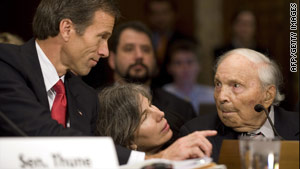
Sen. John Thune of South Dakota helps Frank Buckles, right, speak before a Senate subcommittee.

Washington (CNN) -- The last surviving U.S. veteran of World War I, former Cpl. Frank Buckles, turns 109 on Monday and is still hoping for a national memorial in Washington for his comrades.

Buckles is expected to deliver remarks during a quiet celebration Monday afternoon at his home in Charles Town, West Virginia.

But the old "Doughboy" -- as World War I American infantry troops were called -- has already been outspoken in recent years, urging congressional lawmakers to give federal recognition and a facelift to a run-down District of Columbia memorial in an overgrown, wooded area along the National Mall.

In December, at 108, Buckles testified on Capitol Hill as lawmakers considered whether to fund renovation and give the site "national" monument status. But rival legislation seeks the "national" designation for a 1920s-era memorial located in Kansas City, Missouri.

Congress has not yet decided on the legislation.

In 2008, the old soldier came to Washington and visited that 1930s-vintage District memorial. In his wheelchair, helped along by a military aide, he slowly crossed the cracks in the flagstone walkway, and saw the cracks in the marble gazebo.

Still sharp at only 107, he noted during that visit that the names engraved along the gazebo's marble walls are only of those who hailed from District of Columbia.

Buckles that day also met with then-President George W. Bush at the White House and Defense Secretary Robert Gates at the Pentagon.

Later in 2008, Buckles was the guest of honor at Veterans Day ceremonies at Arlington National Cemetery. He said he considers it his duty to represent his fellow soldiers.

 
Oldest WWI Vet : Frank Buckles

"I have to," he told CNN, "because I'm the last living member of Americans," who fought in what was called The Great War.

As a soldier in the U.S. Army, Buckles was an ambulance driver for U.S. forces in Europe, and once met commanding Gen. John Pershing, near whose grave the more recent Veterans Day ceremony was held.

Buckles was warmly greeted with standing applause by those in uniform and others who had gathered for the commemoration, but he said he did not think the fuss was about him.

"I can see what they're honoring: The veterans of World War I."

"Time has passed very quickly to me," he told CNN after a wreath-laying, "I've had a lot of activity in the last 90 years."

AddThis Social Bookmark Button
Email this post


Army Leans Toward Suicide Ruling  


The mother of Staff Sgt. Amy Seyboth Tirador, a Colonie native slain in Iraq in November, said Friday she believes military investigators are "leaning toward" ruling her daughter's death a suicide.

Tirador, 29, was killed Nov. 4, the victim of a gunshot to the back of her head while walking to an evening work shift on the U.S. military base Camp Caldwell in Kirkush, Iraq, near Iran.

The Army has attributed the fatality to a "non-combat-related incident." Tirador's mother, Colleen Murphy, said she suspects the investigation will find the bullet was self-inflicted.

"They seem to be leaning toward suicide in the questions that they have asked," Murphy said in a phone interview, referring to military investigators. She would disagree with such a finding.

"Amy -- in no way, shape or form -- took her own life," she said. "She was too strong a soldier and she had too much life to live ... no matter what pressures were on her, she knew how to deal (with them)."

Murphy said she has retained an attorney. She also said she would expand on her remarks at a news conference she plans on Feb. 4, the three-month anniversary of her daughter's death.

Tirador, a 1998 graduate of South Colonie High School, was the first female soldier from the Capital Region to lose her life in the Iraq war.

She joined the Army Reserves in 1999 and enlisted into active duty in 2001 as an Army combat medic.
Tirador met her husband, Michael Tirador, during her first overseas assignment in Germany. She won a Bronze Star during her second deployment for the rescue of a higher-ranked soldier during a combat situation.

In her last tour, Tirador was studying to be an Arabic linguist. At the time of her death, she was interrogating enemy combatants and interpreting interviews for Army intelligence at Camp Caldwell.

A spokesman for the U.S. Army Criminal Investigation Command could not be immediately reached Friday.

AddThis Social Bookmark Button
Email this post


US Marines End Role in Iraq  


RAMADI, Iraq - The U.S. Marine Corps wrapped nearly seven years in Iraq on Saturday, handing over duties to the Army and signaling the beginning of an accelerated withdrawal of American troops as the U.S. turns its focus away from the waning Iraqi war to a growing one in Afghanistan.

In Baghdad, meanwhile, Vice President Joe Biden held talks with Iraqi leaders amid growing tensions over plans to ban election candidates because of suspected links to Saddam Hussein's regime.

The White House worries the bans could raise questions over the fairness of the March 7 parliamentary elections, which are seen as an important step in the American pullout timetable.

The Marines formally handed over control of Sunni-dominated Anbar, Iraq's largest province, to the Army during a ceremony at a base in Ramadi - where some of the fiercest fighting of the war took place.

If all goes as planned, the last remaining Marines will be followed out by tens of thousands of soldiers in the coming months. President Barack Obama has ordered all but 50,000 troops out of the country by Aug. 31, 2010, with most to depart after the March 7 parliamentary election.

The remaining troops will leave by the end of 2011 under a U.S.-Iraqi security pact.

But concerns about the success of the election - and perhaps the loss of hard won security gains that the Marines helped cement - are on the rise because of a growing political dispute that could see more than 500 candidates blacklisted because of suspected ties to previous regime.

The changeover at Ramadi, west of Baghdad, leaves the U.S. Army's 1st Armored Division with responsibility over both Baghdad and Anbar, the vast desert province that stretches from western Baghdad to the borders of Syria, Jordan and Saudi Arabia.

The province was once the heart of the deadly Sunni insurgency that erupted after the U.S.-led invasion in 2003. In the battles for control of the cities of Fallujah and Ramadi, the Marines saw some of the most brutal and deadliest fighting of the war.

Violence began dropping off in the province in late 2006 when Sunni fighters - known as Awakening Councils - turned against al-Qaida and sided with the Marines to fight the insurgency.

As many as 25,000 Marines were in Iraq at the peak, mostly in Anbar province. The few thousand who remain - except for U.S. Embassy guards and advisers in Baghdad - are expected to ship out in a matter of weeks.

The upcoming parliamentary election is also considered an important step toward speeding the U.S. troop pullout. But plans to ban hundreds of candidates have raised deep concerns in Washington that the voting could widen rifts between the majority Shiites who gained power after Saddam's fall and Sunnis who are struggling to regain influence.

Biden, who arrived late Friday, had a full agenda of meetings with Iraqi leaders including Prime Minister Nouri al-Maliki, who has strongly supported the blacklist.

Some Sunni leaders have accused the Shiite-led government of using the ban as a political tool. But al-Maliki insists that Iraq must purge all ties to Saddam's Sunni-dominated regime. A vetting panel has put 512 names on the blacklist and more are expected.

AddThis Social Bookmark Button
Email this post


McHugh Prioritizes Support, Outreach  


Secretary of the Army John McHugh gave Pentagon staffers a "preliminary report" after his first three months in office, asking them to continue supporting Soldier and family programs, continue acquisition reform, and focus more on Congressional outreach.

McHugh, who took office Sept. 21, spoke to more than 400 members of the Army staff and secretariat in the Pentagon auditorium at an Army Leader Forum.

He expressed his admiration for those who serve, stating, "The most important thing we do is take care of our Soldiers and take care of our families." There is a "critical interdependence" between Soldiers and families in relation to readiness, he said, especially with an all-volunteer force.

Continuing to improve the availability and excellence of quality-of-life programs is essential after almost nine years of war, even as funding may decrease in coming years, he said, adding this imperative must be balanced with vital efforts to modernize the force.

Facing persistent conflict, he said the Army must transform the way it develops its leaders to prepare them for "hybrid threats" and ambiguous situations. He said the Army must train its leaders to be comfortable in dealing with uncertainty by teaching them "how to think" as well as a doctrinal baseline of "what to think."

"Technology does not in and of itself lift the fog of war," McHugh said. He said leaders need to be comfortable with greater decentralized authority from the troop level to the institutional level in order to encourage bottom-up solutions. Of course, he said the Army must also ensure that robust service-wide standards are in place.
One challenge the Army continues to face, he said, is reforming the acquisition process.

"In too many instances, the so-called traditional acquisition process has not been as agile, flexible and efficient as the force it's charged to support," McHugh said.

He lauded initiatives such as the Rapid Equipping Force and Experimental Task Force, saying the Army must continue efforts to get emerging technologies into the hands of Soldiers quickly. "It's a work in progress," he said, but there's more to be done.

"We have to re-tool our entire existing acquisition processes and develop a more agile acquisition strategy that directly supports the warfighter on the battlefield today, next year and beyond," McHugh said. "And do it in a way that meets the expectations of our overseers on Capitol Hill."

In addition, the Army needs a more robust and effective partnership with Congress, McHugh said. He praised the Congressional Fellowship Program, saying the program is larger now than ever with 26 fellows from the Army on Capitol Hill, and added that the program should continue to grow.

McHugh challenged every Army general officer in the National Capitol Region to take a "direct, personal role" in fostering a relationship with Congress by making "a concerted effort to specifically partner with a member in office on Capitol Hill."

From his perspective of having served 17 years in the House of Representatives, he said the Army must do a better job of explaining needs and reporting achievements because this relationship with Congress is crucial to success in obtaining needed resources.

The secretary concluded his formal comments by thanking the staff and secretariat. He cited his trip last month to Iraq and Afghanistan, saying that warfighters there know they are making a difference.

"You're doing vital work, supporting our troops and making a difference in the lives of millions of people, who like you wake up but who have a different dream - a dream that someday maybe they can enjoy the freedoms, the liberties that this United States Army has given to hundreds of millions across the planet since its inception."

McHugh took questions from audience members, including one who asked whether the number of civilian employees working for the Army would grow beyond the current force in light of President Obama's initiative to replace contractors with government employees when appropriate. The secretary said outsourcing would be examined on a case-by-case basis, and where there was not an essential government responsibility to keep a function in-house, who could do the job most efficiently would be weighed.

"I think our first responsibility has to be to the taxpayer dollar," he said, adding that a "robust interaction" between the public and private sectors will not only stimulate the economy, but provide an Army outreach into communities.


AddThis Social Bookmark Button
Email this post


West Defeats East at All-American Bowl  

SAN ANTONIO - The Army's number one opportunity to honor some of its greatest heroes, wounded warriors, future Soldiers and the nation's top high school football athletes unfolded on Saturday during the All-American Bowl all-star high school football contest at the Alamo dome.

It was the Army's 10th time to sponsor the event that saw the West team dominate the East 30-14 in front of a crowd of 34,126 and a nationally televised audience.

During pre-game activities, 90 Soldier-Heroes, representing the ranks of active duty, Reserve, and National Guard, were paired with a player from either the West or East teams and introduced at midfield prior to kickoff. The Soldier-Heroes represented Soldiers who were awarded the Silver Star, Bronze Star or Purple Heart for actions during previous deployments.

This year, during a series of week-long activities leading up to game day, the Department of the Army Soldier of the Year, the Army's NCO of the Year, along with the Recruiter of the Year and both active-duty and Reserve Drill Sergeant of the Year were also honored.

"There are so many great people who serve our country, and it has been a great honor and opportunity for me to interact with some of the greatest football players in the country, many who will get the opportunity to go on to the NFL," said Sgt. Clancey Henderson, the Army's Soldier of the Year, currently stationed at Fort Riley, Kan.

The 2010 contest also saw a player matched with his Soldier-Hero dad. 1st Sgt. Aleki Potoae, first sergeant of Company C, 1st Battalion, 23rd Infantry, Fort Lewis, Wash., was matched with his son, Sione, a 6'3" 285-lb. defensive end with the West team.

"It means a lot to be here as a Soldier-Hero and have my son playing in the game," said Potoae. "In 2003 I was here as part of a detail and brought my son back a hat and a game coin to help motivate him. It's very important for young people, like my son, to understand what the Army represents and the opportunities available for those who work hard and take the education and experience."

As in previous years, Soldier-Heroes attended a series of events that offered opportunities for them to interact with the nation's top athletes that ranged from a barbecue social to skills competitions and an award banquet and presentation.

"This week has been tremendous," said Sgt. 1st Class Robert A. Barnes, a Soldier-Hero assigned to the 101st Airborne Division at Fort Campbell, Ky. "I've had an opportunity to meet so many wonderful people, from all walks of life, both military and civilian, to include the player that I'm sponsoring, and his family. I've been involved in several eating events and an event that highlighted country singer Darryl Worley."

"What impressed me the most was the size of the players and how intrigued we have been with one another," said Spc. Jason L. Whitehorse, a New Mexico native also stationed at Fort Campbell. "Even though I've never been here before, or met anyone here, both the Soldier-Heroes and players have really impressed me."

The history of the game and the stories of self sacrifice and courage of Soldiers hit home with one Soldier-Hero who met face-to-face with two legends from both sides.

"While in the lobby of my hotel, I was called over by a man who wanted to thank me for my service," said Army Reserve Staff Sgt. Michael Smith, a chemical weapons NCO with the 375th Chemical Company in St. Louis, Mo. "After talking to him for awhile, I noticed a huge ring on his finger. When I asked about it, he held it up with pride and told me he had been a head coach years ago and this was his ring from that time. He asked me if I had ever seen the movie, 'Remember the Titans.' I told him that I had seen it and that it was a great movie. He tapped his chest and said, 'Coach Boone, nice to meet you.'"

"It was amazing sitting there talking to an icon of American football," continued Smith. "Not three minutes later, I got onto an elevator and a man asked me how I was doing. I explained that I had just met Coach Boone and talked about how great it was to meet an American legend. The man smiled and reached into his pocket and pulled his hand out to shake mine. He then said, 'Now you've just met another legend,' then handed me a coin and walked out of the elevator. When I examined the coin, I realized it was Major General Brady, a Medal of Honor recipient from the Vietnam War."


AddThis Social Bookmark Button
Email this post


Reserve GI Still Recruiting after 60 Years  


None are so old, Thoreau once wrote, as those who have outlived their enthusiasms.

By that standard, Sgt. Maj. Raymond Moran, the most chronologically advanced recruiter in the Army Reserve, might well also be its most youthful.

"This isn't work; it's a labor of love," says Moran, a beloved figure at Fort Meade who is embarking on his 60th year of doing what he loves most: finding prospects for the Army, then putting his cheerful personality to work guiding their careers.

Moran, who turned 80 last November, never guessed it would last this long. He enlisted in his hometown of Latrobe, Pa., in 1948, did basic training in Kentucky, and shipped out to Japan, where he helped keep the peace in post- World War II Tokyo.

But when the Korean War broke out in 1950, Moran and his unit, an infantry battalion in the 1st Cavalry Division, were called into battle and eventually moved deep into North Korea.

He has been a soldier ever since. He recruited in Washington, Pa., for 12 years; earned a Purple Heart (and his enduring nickname, "The Old Soldier") in Vietnam; and helped get the all-volunteer Army started in the 1970s.

At 60, Moran volunteered to serve during Desert Storm -- and did so. He tried to do the same in the wake of 9/11, at 70, but the Army drew the line. "At that age, you have to be a doctor or they won't take you," he says with an uncharacteristic pout.

Over the years, his country noticed his service. Moran, who has recruited well over a thousand men and women, is the only living person after whom Fort Meade ever named a street. Last year, the Army officially dubbed its new recruiters' hall of fame The Sgt. Maj. Ray Moran "Old Soldier" Hall of Fame -- and inducted Moran into the Fort Jackson, S.C., shrine that day.

Moran reports each morning to a Fort Meade office so jammed with posters, medals, trophies and autographed photos he has to keep a table in the hall to hold the overflow. He spoke with The Baltimore Sun of a long career, the changing face of his craft, and youth.

Your career really started in Asia, during the Korean War. What was it like there? 

In the fall of 1950, everyone thought the war was over. Gen. MacArthur even asked my unit, the 7th Cavalry Regiment, to come back from Korea and "parade" in downtown Tokyo on Armistice Day. Bob Hope had come over to do one of his shows

Then we got awful news. In early November, the Chinese Communists came out of nowhere and attacked our buddies [at the Yalu River, in North Korea; more than 800 were killed.] We didn't even realize that army existed.

We had to go out to find soldiers who'd been killed. Many were shot in the back of the head, their hands tied behind them with barbed wire. That's who the enemy was.

Any good memories of that time?

When I was at the front lines, all I knew about my brother was he'd been assigned to a unit at APG in Maryland. But one day, here came this Army Jeep carrying an enlisted man. It was Sam! The 2nd Mortar Battalion had been sent over.

We sat down and wrote a letter home -- he'd write a little in his handwriting, then I'd write a little in mine. My parents kept that letter forever.

You've been recruiting since you returned in 1951. What's the appeal?

[After that war] we had to maintain an Army to defend this great country, to keep it free. And even if war is hard, I always felt I was helping somebody. I'm delighted to talk to anybody who's interested in the military.
They felt I was helping them, too. I've never had a complaint. My [recruits] kept me informed. I still get letters and postcards -- but now they're not from Korea or Vietnam, but from Iraq, Afghanistan, Kuwait.

What's the hardest part of the job?

It's not a job you just do a little bit, then quit for a while and pick it up again. You've got to be [recruiting] all the time -- handing out your card, letting people know you're around and available.
If they think kindly of you, if they respect you, they'll refer their friends and family members to you. It works well when you have a good reputation.

Any pointers on that?

I tell new recruiters, "Always bring family pictures and have them in your office. They're a reminder of something precious in your life -- a reminder to always tell the truth when you're talking to somebody who wants to serve their country."

There was a big sign in the auditorium of my high school. It said, "The truth shall make you free" And that's exactly what it does. You feel like you're a better man or woman all the way around.

Why is truth-telling such an issue for recruiters?

You don't want to tell anybody an untruth. Today, you don't want to tell anybody, "You're not going to be deployed." We've been in a war for eight years now, and we have all kind of casualties coming back. So you want to tell the truth. And when you do, you're respected for it. They understand.

Your career included the Vietnam War, when popular sentiment ran against the mission. Did you feel that?

I ran into that a little bit when I was [running] the Boston Recruiting Battalion. We had a recruiting station downtown, not far from Harvard. One of my sergeants called me one day and said, "Sergeant Major, we have some Harvard students who are donating their furniture." I said, "What do you mean?" He said, "They're throwing their chairs through our window." [Laughs.]

So yes, we had problems. But you replaced the window and continued to serve your country. You didn't quit because you had some people who opposed what you were doing.

You volunteered to go to Vietnam?

Well, they put out word they were looking for recruiters. They do that even today, with Iraq and Afghanistan. They become retention and re-enlistment sergeants. When I called in [in 1969], I said, "Do you have any need for sergeant majors?" They had two vacancies, one in the 101st Airborne, one in the "1st Cav." I said "Put me down for one."

Did you ask your wife, Barbara, first?

No, I didn't. [Laughs.] Her reaction was to say, "I knew you would!" She wasn't happy, but she has always been a wonderful Army wife. ... She's still a great volunteer, sending packages to the soldiers overseas.
In May of 1970, she wrote and said, "you volunteered to go over; now I'd like you to volunteer to come back. Please don't extend." I honored that request.

You were right there when the draft ended and volunteer soldiering began. 

[That year] I got the best news I ever could have, though I didn't know it then. I was asked to be [senior NCO] of the 1st Recruiting Brigade at Fort Meade. They said, "Your job is going to be to start the new volunteer Army in that area -- you and the new colonel." We had to go out, open new recruiting stations, take care of housing our new recruiters, get phones and office space. I was on the ground floor of the volunteer Army.

Have you ever had second thoughts about America's missions?

No. I always thought they were well thought out, and important, and [if] they get to us, they're something that's so vital, it's important for us to help accomplish the mission. That's something soldiers are taught: Never leave a fallen hero behind; accomplish the mission. Whatever the mission is, lean forward in a foxhole.

How did things change when the military became all-volunteer [in 1973]?

It made an enormous difference. The drafted soldier did a great job for this country. He was a great warrior. But he didn't want to serve. Whereas the fellow who goes to the recruiter is volunteering to go. Today's military can perform its duties with motivated soldiers.

When you recruit a soldier in 2010, he or she will almost surely end up in a war zone. Does that change your feelings?

No. We're aware of what our country needs. We're here to help out in that. And [the recruits] know that. These young men and women today are into computers; they know everything that's happening. They even know what [career] options they want when they come in.

As a modern recruiter, do you keep up on things in Afghanistan and Iraq?

Oh, yes. [I tell people] Afghanistan will be like what North Korea was for me. It was bitter cold, like it is outside right now. We never slept in a bed for a year. ... I have a friend who told me his son is over there now, living in a tent. I said, "As bad as a tent is, it's still better than having no tent and still living out in the elements, in a foxhole with a sleeping bag wrapped around you." There are going to be a lot of hardships for our soldiers who serve over there.

Does today's slow economy help you in recruiting?

We know unemployment is bad. We'd rather see our country fully employed. That means we have to work harder, but that's what we want. But yes, it's a factor that comes into play -- one of many.

Do you have any other recruiting tips?

I've always felt if you're going to take a young man or woman away from [family], you should, out of respect, stay close to that family. I stay in touch by phone, e-mail, postcard. I get calls from all over. The family members become friends.

I have a saying: "Friends are better than money." I've been lucky enough to make many, many friends.

How are you still going at your age?

I've just always liked this. I continued on, and it has worked out beautifully. I certainly don't feel 80.
Barbara and I have always said, "health and happiness first." And as we age gracefully, we begin to realize we're slowing down -- it's part of the way things happen.

Do you work full-time?

My doctor found a bit of a heart constriction. He said, "I know you think age is unimportant, but ... your body is telling you different." I used to work even on Saturdays and Sundays, but now I work from 7 to 11 [in the morning] on weekdays, go home and take care of myself and Barbara. She's not used to having a husband home.

You're starting your 60th year as a recruiter. Do you plan to be doing this in another 10 years?

I'll help out as long as my health holds up. And I'll do it with a great deal of personal pride.

AddThis Social Bookmark Button
Email this post


Suicide Rates Spike for Young Vets  

WASHINGTON - The government says the suicide rate has gone up among 18- to 29-year-old men who've left the military.

According to preliminary data from the Department of Veterans Affairs, the suicide rate for these veterans went up 26 percent from 2005 to 2007.

It's assumed that most of the veterans in this age group served in Iraq or Afghanistan.

The data also showed that while this group of veterans were more likely to kill themselves in 2005 if they were using VA health care, they were less likely to do so two years later.

Last year, the Army saw a record number of suicides.

The VA calculated the numbers using Centers of Disease Control and Prevention numbers from 16 states.


AddThis Social Bookmark Button
Email this post


Have you ever wondered what it's like inside a can of whoop ass?  


AddThis Social Bookmark Button
Email this post


Copyright © 2010 | The Military Post | All Rights Reserved