Corps Cracks Down on Excessive Tattoos  


ARLINGTON, Va.  —  Maintaining high standards of military appearance is a pillar in the Corps’ history that has distinguished Marines for more than two centuries. Today, as the tattoo trend continues, the Corps still strongly supports the notion that excessive tattoos detract from the professional appearance expected of a Marine.

Recent guidance issued by the commandant is not intended to discourage Marines from decorating their bodies. However, it informs Marines how to stay in compliance while ensuring that no tattoos are of a nature that would bring discredit upon the Marine Corps.

“We have realized that we needed to provide more amplifying guidance to clear up questions our Marines have about the existing policy to allow them more opportunities within the Corps and once they leave the service,” Sgt. Maj. Carlton W. Kent, sergeant major of the Marine Corps said.

The overall intent of the policy is to ensure Marines can remain worldwide assignable, by maintaining the professional demeanor and high standards expected of the Corps.  Additionally, the commandant wants to inform Marines that tattoos can negatively impact their future career goals, especially if that involves law enforcement.

“Marines are recognized around the world because of our high standards of military bearing and appearance,” Kent said.  “We want Marines to set the example and be assignable to any billet, in any location.”

The policy seeks to balance the personal desires of Marines with their responsibility to set the example and present a sharp military appearance.

“Tattoos of an excessive nature do not represent our traditional values and are contrary to our professional demeanor and the high standards America has come to expect from us,” said Maj. Shawn D. Haney, public affairs officer, Manpower and Reserve Affairs in Quantico, Va.

Marine Administrative Message 029/10, released Jan. 15, clarifies past and current policies. It prohibits sexist, racist, eccentric, vulgar or otherwise offensive tattoos. Tattoos that express an association with illegal drugs, anti-American content or affiliation to any extremist group or organization are also prohibited.

The policy also prohibits tattoos on the head, neck, hands, fingers and wrists as well as full, half and quarter sleeves visible in the standard physical training uniform.

Individual tattoos visible in the PT uniform will be no larger than the wearer’s hand, and officers will be limited to a maximum of four tattoos visible in the PT uniform.

Marines with grandfathered sleeves have no restrictions for reenlistment or promotion. However, they are no longer eligible for any enlisted-to-officer program, recruiting duty or Marine Security Guard duty.

“Marines need to understand the intent of the policy and the specific guidance that is published so that they can make an informed decision before getting a tattoo,” Kent said.

The tattoo policy is in place to deter Marines from excessive tattooing, which can hinder their future career opportunities in the Corps or as civilians.

“As we adjust our policy on tattoos so are many civilian agencies,” said Kent. “I have met with many former Marines who told me they could not even get a job at a fast food restaurant because of their tattoos.”

Recently, a team at Headquarters Marine Corps conducted research on state police and highway patrol tattoo policies. All 50 state police or patrol departments were contacted about their respective tattoo policies. Overall,  39 states have official written policies covering tattoos and body art or modifications, as well as other personal appearance standards.

Former Marine, John Beekman, is a 16-year-veteran detective in Chandler, Ariz.  He advises service members to consider their future career choices before getting new ink.

“Keep in mind the tattoo itself; the type, size, and [location on your body] - how will it affect you later?” said Beekman.  “When you’re young and motivated you’re not thinking about the future. But, one day you will get out of the Marine Corps and perception is reality. The general public is going to look a person with [excessive] tattoos and make an immediate judgment. “

Beekman attests to the fact that many law enforcement agencies are also pulling in the reins on excessive tattoos.

“Our department policy on tattoos states that if visible while working in an official capacity, all tattoos must be covered,” he said. “This policy became permanent in 2008.”

“As of this date, no applicants have been turned away simply for excessive tattoos. However, if an applicant has visible tattoos that are deemed inappropriate, or those visible tattoos that cannot be covered must be eliminated if the applicant wishes to be hired.”

The Chandler Police Department, along with many departments across the nation agree with the Corps’ tattoo policy standards prohibiting tattoos that are offensive to a person's race, color, religion, sex, or national origin.

The driving force behind the amplification of the tattoo policy is to ensure that Marines can prosper no matter what career path they choose. 

“The success of our Marines during their career, as well as afterward, is important,” Kent said.

Although many may not agree with the policy, all Marines must adhere to it.

“Tattoos are one of the bonds we have as Marines, [but] setting the standard has always been our job,” said Sgt. Stephen B. Dolo, an anti-tank missileman currently serving as the assistant training chief for Headquarters Battalion, Headquarters Marine Corps, who personally has two tattos within regulations.

Marines not in compliance with this policy should have their tattoos grandfathered via the appropriate channels within their chain of command by June 1.

AddThis Social Bookmark Button
Email this post


Marines Join Chorus Urging Caution on Gay Ban  


WASHINGTON - The Marine Corps commandant said Wednesday that the ability of U.S. troops to fight and win wars must trump other concerns as the nation considers whether to let gays to serve openly in the military.

In testimony before a House committee, Gen. James Conway said he supports a Pentagon assessment to determine how to lift the ban. But he also suggested that civil rights ultimately would have to take a back seat if it meant tampering with the military's ability to protect the country.

"That's what they have been built to do under the current construct and I would argue that we've done a pretty good job bringing that to pass," he told the House Armed Services Committee.

"My concern would be that somehow that central purpose or focus were to become secondary to the discussion," he said.

Conway is seen as the most resistant among the service chiefs to efforts under way in Congress and the Pentagon to repeal the 1993 "don't ask, don't tell" law. But his testimony indicates that he won't stand in the way as Defense Secretary Robert Gates undertakes a comprehensive study on how to lift the ban without hurting the force.

President Barack Obama has pledged to change the policy, saying it unfairly punishes patriots who want to serve their country. Congress would have to agree, and it's unclear whether Democrats would have enough votes to pass the legislation.

The opinion of the service chiefs, and Conway's in particular, is expected to factor heavily into the debate.

It's Conway's job to ensure that young recruits are prepared to deploy to dangerous and remote regions of the world. Because Marines frequently represent the military's first line of attack and are dropped behind enemy lines, unit cohesion and morale are considered vital to their ability to succeed.

In 1993, opponents of President Bill Clinton's proposal to lift the ban on gays argued successfully that it might hurt military effectiveness. Facing resistance in Congress, Clinton settled for "don't ask, don't tell," which allowed gays to serve so long as they kept their sexual orientation a secret.

Conway's concerns have been echoed by other service chiefs.

On Tuesday, Army Chief of Staff Gen. George Casey and Air Force Chief of Staff Gen. Norton Schwartz said they had serious concerns about lifting the ban with two wars raging.

Chief of Naval Operations Adm. Gary Roughead told House lawmakers on Wednesday that he, too, wants the study to be complete before any changes are made.

"That needs to be done because only with that information can we discuss the force that we have, (and) not someone else's," Roughead said.

Britain, Canada, Australia and Israel allow gays to serve openly. Other nations already allow women to serve on submarines; the Navy lifted its ban this month.

Both Conway and Roughead said they would oppose an immediate freeze on firings under "don't ask, don't tell" until Congress can consider broader legislation repealing the 1993 law.

Democratic Sen. Carl Levin of Michigan, chairman of the Senate Armed Services Committee, has proposed a freeze as a way of allowing gay troops to fight without worrying that they could lose their job.

"Half measures, I think, would only be confusing in the end," Conway said.

Christopher Preble, head of foreign studies at the Cato Institute think tank, said that the service chiefs recognize that change is inevitable, but that the military shouldn't wait too long to determine its next move.

"The military as an institution should not find itself so out of step with the public at large that it cannot relate to the society it's defending," he said.

AddThis Social Bookmark Button
Email this post


VA Secretary Outlines Goals for Vets  

FORT BLISS, Texas - More than 50 veterans gathered to hear Secretary of Veterans Affairs Eric K. Shinseki speak about his goals to improve the quality of life for veterans at the El Paso VA Health Care System facility.

Shinseki, who is a member of President Obama's cabinet, was hosted by three local members of Congress, including Rep. Silvestre Reyes, Rep. Ciro Rodriguez and Rep. Harry Teague.

During Shinseki's visit, he toured the VA facility and the Fort Bliss National Cemetery, and he participated in a veterans roundtable before addressing the public on the purpose of his visit.

In his speech, he addressed three specific goals targeting programs affecting the nation's veterans: reducing the growing backlog of claims, improving the quality of VA healthcare facilities and reducing homelessness among all veterans.

Teague agreed that "there is a definite culture change happening within the area of veterans affairs."

Regarding the backlog, Shinseki has established four pilot projects: one in Pittsburgh; others in Little Rock, Ark.; Providence, R.I.; and Baltimore that will help the department identify how to simplify claims and minimize obstacles that keep veterans from registering with the VA.

As for the second goal, he shared that the 2011 budget, while under review, includes a financial increase for the Veterans Benefits Administration, which will allow for more medical personnel and better facilities.

Even though more than 131,000 veterans are homeless, Shinseki stressed he won't be able to take them all off of the street; rather, he spoke of the importance of opening up jobs and enhancing education for veterans, using new programming and funding, such as the GI Bill.

Shinseki said the Obama administration is planning to increase the Veteran Affairs budget by 15 percent in 2010, which is the largest increase in more than 20 years.

As for Shinseki's goals, Teague and the other congressmen said they have absolute confidence in his leadership and that he will accomplish all he can during his term.

"He openly addresses the hurdles we face in the VA," Teague said. "He's not trying to sweep them under the carpet."

AddThis Social Bookmark Button
Email this post


Taliban Puts up Fight in Marjah  


MARJAH, Afghanistan - It could take weeks to reclaim the Taliban stronghold of Marjah, a top Marine commander said Sunday as thousands of U.S. troops and Afghan soldiers fought for a second day in NATO's most ambitious effort yet to break the militants' grip on Afghanistan's dangerous south.

"That doesn't necessarily mean an intense gun battle, but it probably will be 30 days of clearing," Brig. Gen. Larry Nicholson said. "I am more than cautiously optimistic that we will get it done before that." 

Squads of Marines and Afghan soldiers occupied a majority of Marjah, but gunfire continued as pockets of militants dug in and fought. Sniper fire forced Nicholson to duck behind an earthen bank in the northern part of the city where he toured the tip of the Marines' front line held by Lima Company, 3rd Battalion, 6th Marines.

"The fire we just took reflects how I think this will go - small pockets of sporadic fighting by small groups of very mobile individuals," he said.

Explosions from controlled detonations of bombs and other explosives were being heard about every 10 minutes in the area.

"There's really a massive amount of improvised explosive devices," Nicholson said. "We thought there would be a lot, but we are finding even more than expected."

The second day of NATO's largest offensive since the 2001 U.S.-led invasion of Afghanistan also was marked by painstaking house searches.

Using metal detectors and sniffer dogs, U.S. forces found caches of explosives rigged to blow as they went from compound to compound down streets riddled with thousands of homemade bombs and mines. Shots continued to ring out in some neighborhoods.

They also discovered several sniper positions, freshly abandoned and booby-trapped with grenades.

The troops also found two large caches of ammonium nitrate - a common ingredient in explosives - totaling about 8,800 pounds (4,000 kilograms), said Lt. Josh Diddams, a Marine spokesman.

"We're in the majority of the city at this point," Diddams said. He said the nature of the resistance has changed from the initial assault, with insurgents now holding ground in some neighborhoods.

"We're starting to come across areas where the insurgents have actually taken up defensive positions," he said. "Initially it was more hit and run."
NATO said it hoped to secure Marjah, the largest town under Taliban control and a key opium smuggling hub, within days, set up a local government and rush in development aid in a first test of the new U.S. strategy for turning the tide of the 8-year-old war.

At least two shuras, or meetings, have been held with local Afghan residents - one in the northern district of Nad Ali and the other in Marjah itself, NATO said in a statement. Discussions have been "good," and more shuras are planned in coming days as part of a larger strategy to enlist community support for the NATO mission, it said.

Afghan officials said Sunday that at least 27 insurgents had been killed in the operation. 

Most of the Taliban appeared to have scattered in the face of overwhelming force, possibly waiting to regroup and stage attacks later to foil the alliance's plan to stabilize the area and expand Afghan government control in the volatile south.

Two NATO soldiers were killed on the first day of the operation - one American and one Briton - according to military officials in their countries. At least seven civilians had been wounded, but there were no reports of deaths, Helmand provincial spokesman Daoud Ahmadi said.

More than 30 transport helicopters ferried troops into the heart of Marjah before dawn Saturday, while British, Afghan and U.S. troops fanned out across the Nad Ali district to the north of the mud-brick town, long a stronghold of the Taliban.

Maj. Gen. Gordon Messenger told reporters in London that British forces "have successfully secured the area militarily" with only sporadic resistance from Taliban forces. A Taliban spokesman insisted their fighters still controlled the town.

President Barack Obama was keeping a close watch on combat operations, White House spokesman Tommy Vietor said.

Vietor said Defense Secretary Robert Gates would have the top U.S. commander in Afghanistan, Gen. Stanley McChrystal, brief Obama on Sunday.

In Marjah, most of the Marines said they would have preferred a straight-up gunbattle to the "death at every corner" crawl they faced.

"Basically, if you hear the boom, it's good. It means you're still alive after the thing goes off," said Lance Corp. Justin Hennes, 22, of Lakeland, Florida.

Local Marjah residents crept out from hiding after dawn Sunday, some reaching out to Afghan troops partnered with Marine platoons.

"Could you please take the mines out?" Mohammad Kazeem, a local pharmacist, asked the Marines through an interpreter. The entrance to his shop had been completely booby-trapped, without any way for him to re-enter his home, he said.

The bridge over the canal into Marjah from the north was rigged with so many explosives that Marines erected temporary bridges to cross into the town.

"It's just got to be a very slow and deliberate process," said Capt. Joshua Winfrey of Stillwater, Oklahoma, a Marine company commander.

Lt. Col. Brian Christmas, commander of the 3rd Battalion, 6th Marines, said U.S. troops fought gunbattles in at least four areas of the town and faced "some intense fighting."

To the east, the battalion's Kilo Company was inserted into the town by helicopter without meeting resistance but was then "significantly engaged" as the Marines fanned out from the landing zone, Christmas said.

Marine commanders had said they expected between 400 and 1,000 insurgents - including more than 100 foreign fighters - to be holed up in Marjah, a town of 80,000 people that is the linchpin of the militants' logistical and opium-smuggling network in the south.

The offensive, code-named "Moshtarak," or "Together," was described as the biggest joint operation of the Afghan war, with 15,000 troops involved, including some 7,500 in Marjah itself. The government says Afghan soldiers make up at least half of the offensive's force.

Once Marjah is secured, NATO hopes to quickly deliver aid and provide public services in a bid to win support among the estimated 125,000 people who live in the town and surrounding villages. The Afghans' ability to restore those services is crucial to the success of the operation and in preventing the Taliban from returning. 


AddThis Social Bookmark Button
Email this post


Marines Wait in Cold for Afghan Offensive  


OUTPOST BELLEAU WOOD, Afghanistan - Take a desert of yellow-orange dust so flat it looks like Mars, with a freezing wind that blows so hard it can lift a large tent. 

Add hundreds of U.S. Marines, squads of Afghan soldiers, some Drug Enforcement Administration agents, a few private contractors, along with dozens of armored cars, mine breachers and an improvised helicopter landing zone.

That's Outpost Belleau Wood, a Marine base near the edge of the Taliban-controlled town of Marjah, which the Marines plan to attack in the coming days.

It took barely a week for the 3rd Battalion, 6th Marine Regiment to create the outpost from scratch.

They bulldozed earth berms to make a protection wall, pitched lines of pup-tents that bend and wobble in the gale, and set up batteries of mortars and 155-millimeter artillery cannons.

"Those guns started shooting the night they got here," said the battalion commander, Lt. Col. Brian Christmas, as he leaned forward against the wind while walking through the base in full body armor and helmet.

Named after a World War I battle where the 6th Marines earned the label "devil dogs" for the ferocity of their fight against German troops, Belleau Wood lies about 7 miles (10 kilometers) north of Marjah.

Several units from the battalion are already pushing in toward the town, where an estimated 600 fighters are entrenched. While the outpost has been hit only once, companies closer to Marjah face daily skirmishes and bombings.

Marjah is the biggest community in southern Afghanistan that is under Taliban control and a center of their logistical and drug-smuggling networks. The NATO command believes restoring government control there would go a long way to discrediting the Taliban among Afghans in a part of the country where the militants have been strong for years.

The offensive proper is expected to be the biggest in the nine-year Afghan war, and troops on the outpost are all waiting for battle.

Dozens of Marine engineers have been rehearsing how to lay out massive metallic bridges they plan to use when troops will need to cross the canals surrounding Marjah. Route clearance teams were also fine-tuning their tactics to detect the bombs that litter the area.

NATO commanders have been outspoken on their plans to take Marjah. But they've remained tightlipped on one key bit of information: timing.

Few know when the offensive will begin, and those who do are saying nothing. So the Marines are in the starting blocks, waiting in the cold.

"The wait is part of the fight," says Hospital Corpsman 1st Class Daniel Perez, a Navy medic. "It gives people the time to pump up with anticipation."

Marjah is suspected to be one of the biggest, most dangerous minefields NATO forces have ever faced, and hundreds of the fighters barricaded inside could be planning to fight until death.

But Perez said he hasn't seen anyone frightened by the fight - "or if they are, they're hiding it very well."
He says waiting, however long, doesn't matter for the Marines.

"It's almost like the Olympics," he said. "You train and train and train ... and this is finally the big show." 


AddThis Social Bookmark Button
Email this post


Tearful Goodbye for Fallen Marine  

"This country has indeed lost another hero, and my family has lost our beloved David."


Leonard Smith addressed about 1,200 people who came out to say goodbye to his son, Sgt. David Smith, 25.

"Your presence here today pays tribute to not only Sgt. David Smith, but to all of our fallen warriors who answered the call of duty willingly -- willingly -- and proudly served their country and made the ultimate sacrifice, and gave their lives so we could live in freedom," Smith said.

The funeral service at the Frederick Christian Fellowship drew Frederick High School graduates, East Carolina University students, Marines and countless others who remembered Smith's laugh, dance moves, stubbornness and love for his family.


Brian Forse, Smith's brother-in-law and former sergeant, recalled several conversations they had about family while serving in Iraq together. He joked about a time during training when he had just been promoted to corporal and Smith decided to mess with him and ignore his orders to show who was really in charge.
Speaking in the packed church, Forse expressed his more personal feelings about Smith, saying he embodied all the qualities a Marine should have.
"I remember the spark I saw in your eyes when we talked about firefights and combat and what you might see in the fog of war; I always knew there was something special about you," Forse said. "I want you to know that I never doubted you, I always knew you would make the right decisions and react appropriately no matter what was presented to you. I was and still am proud to call you my Marine."

Smith's girlfriend, Kimberly Mott, also spoke to the group, saying he was the most loving man she'd ever met and cared more about his family than anything else in the world.

"He put his heart and his soul into everyone he ever knew," she said. "Every time he'd call home, he was just so eager to learn about everybody. He never wanted to tell me what was going on (in Afghanistan), his heart was here; how are they, how's my family?"

Kristen Forse, Smith's sister, said the ceremony was beautiful. Brian Forse said he thought it was a fitting tribute to Smith and thanked the Marines who served with him and Smith for coming out and showing their support.

"There's a comfort in the brotherhood we have. It kind of gives you peace," Brian Forse said.

Among the guests were Cpl. George O'Sullivan and Lance Cpl. Michael Hoey, who were injured in the Jan. 23 suicide bombing that killed Smith and two other service members in the 4th Light Armored Reconnaissance Battalion Company B. Leonard Smith recognized them at the beginning of the funeral, and the guests thanked them for their service through a standing ovation.

Also at the funeral were Maryland Gov. Martin O'Malley and many top Fort Detrick officials. Leonard Smith works at the U.S. Army Medical Research Institute of Infectious Diseases, and Fort Detrick showed sympathy to its employee by flying flags at half-staff for the past few days, as well as bringing out many soldiers to help serve food after the service. "I came to pay my respects to a Marine who served bravely and who, from everything I read in the newspaper, was well-loved by his community and his family, and who loved being a Marine," said Maj. Gen. James Gilman, commander of the U.S. Army Medical Research and Materiel Command.

The snowy roads and the threat of more snow in the afternoon hampered the burial plans at Arlington National Cemetery. Smith's grave site was covered in more than two feet of snow, so the Marines performed an abbreviated ceremony in another part of the cemetery. They folded a flag to present to Smith's mother, Mary Jane McWilliams, played taps and gave a three-volley salute.

A few hundred people, many in two chartered buses, drove to the Virginia cemetery, with the funeral procession winding down I-270 and the Beltway. The Frederick County Sheriff's Office, accompanied by the Frederick Police Department and the Maryland State Police, blocked traffic for the procession throughout almost all of the two-hour ride. 

AddThis Social Bookmark Button
Email this post


Marines Brace for Upcoming Afghan Battle  

CAMP LEATHERNECK, Afghanistan - U.S. troops and their Afghan and NATO allies are planning their biggest joint offensive since the Afghan war's start, targeting a town in the volatile south known as a Taliban stronghold and a hub of their lucrative opium trade, officers said Wednesday.

No date for the start of the offensive has been released for security reasons. But U.S. commanders have said they plan to capture the town of Marjah, 380 miles (610 kilometers) southwest of Kabul, this winter.

It is to be the first major offensive since President Barack Obama ordered 30,000 more U.S. troops to Afghanistan, and many of the Marines set to participate arrived as part of the surge.

Up to 125,000 people are believed to live in the district around Marjah, an agricultural center in Helmand province surrounded by a maze of irrigation canals built with American aid in the 1950s and 1960s. About 80,000 people live in or around the town itself.

Between 600 and 1,000 Taliban and foreign fighters are thought to operate in the area, U.S. officers say. NATO officials won't say how many NATO and Afghan troops have been earmarked for the offensive, but they are expected to vastly outnumber the Taliban and their allies.


In Kabul, NATO spokesman Brig. Gen. Eric Tremblay told reporters that the operation will include at least 1,000 Afghan police and thousands of Afghan soldiers as well as thousands of NATO troops. U.S. officers say the offensive will involve the highest number of Afghan forces in any joint operation to date.

Afghan Defense Ministry spokesman Gen. Mohammad Zahir Azimi did not specifically mention Marjah, but told reporters in Kabul that a large operation is coming "in the near future" in Helmand. He said it will "separate the local people from the terrorists in the area."

Fighting escalated in Helmand in 2006, and the sprawling southern province was transformed into one of the deadliest parts of the country for NATO forces.

Last spring, thousands of U.S. Marines arrived in the province to reinforce the British military. British and American forces launched twin operations to try to stabilize the area before the August presidential election, in which turnout in Helmand was extremely low.

U.S. officials have spoken publicly about plans to take Marjah in hopes that many civilians will leave the town, along with Taliban fighters who are not deeply committed to the insurgency.

Commanders believe support of the local population is crucial to establishing an Afghan administration as quickly as possible and to help NATO troops detect the numerous improvised explosive devices, or IEDs, that they expect to face in Marjah.

Two U.S. service members were killed by a bomb Tuesday in southern Afghanistan, but NATO did not specify the precise location.

Col. George Amland, the deputy commander of Marines in Helmand province, said the Taliban force includes "hundreds of idiots running around Marjah right now waiting to aggregate" and confront the NATO and Afghan troops.

He expects the Taliban ranks will "dwindle very quickly into a very manageable number" by the time the fighting begins.

Amland dismissed most of the Taliban force as just "in the Taliban's employ" and said that local opium poppy growers and opium dealers will abandon the militants quickly.

That leaves the "dyed-in-the-wool Taliban," Amland told reporters in Camp Leatherneck, the main Marine Corps base in southern Afghanistan. He estimates there are "a couple of hundred of those that are rallying the rest of the cause." 

The militants are believed to include about 100 to 150 foreign fighters, including Arabs, Pakistanis, Uzbeks, Chechens and a few Yemenis, said Maj. Jundish Jang Baz, of the Afghan National Army.

The problem, he added, is that NATO isn't completely sure whether it can rely on all the forces supposed to be on its side. Jang Baz said the locally hired Afghan police were less than reliable.

"We think they're working with al-Qaida in Marjah," Jang Baz said, adding that he expected the Taliban to "scatter like ants."

"The real challenge is to make sure they don't flee with enough weapons to start another fight somewhere else," he said.

Azimi also said an investigation was still under way into a NATO airstrike that killed four Afghan soldiers last week in Wardak province.

The fighting broke out when a joint U.S.-Afghan force came under fire near a remote highway outpost and called in the airstrike. Both sides have said it appeared to be a case of mistaken identity.

The U.S. Army Special Operations Command denied claims by Afghan officials that the troops involved were special forces. 


AddThis Social Bookmark Button
Email this post


Marines Prepare for Memorial March  

MARINE CORPS AIR STATION YUMA, Ariz.  — Marines from the Installation Personnel Administration Center at the Marine Corps Air Station in Yuma, Ariz., began training with a predawn 5-mile hike around base for the 21st annual Bataan Memorial Death March.

The annual 26.2-mile march, to be held at the White Sands Missile Range, N.M., on March 21, 2010, commemorates the nearly 75,000 Americans and Filipinos forced across the hellacious terrain of the Bataan Peninsula to internment camps by the Japanese during World War II.

The Marines are among at least a dozen from the air station planning to participate this year.

This will mark the second time a group of IPAC Marines have participated in the event. The first was in 2008, when four Marines completed the course in 9 hours, 51 minutes. Members of Marine Wing Support Squadron 371 and Marine Air Control Squadron 1 participated in 2001 and 2005, respectively.

Of 2008’s former four, only Gunnery Sgt. Fred Suniga, staff noncommissioned officer in charge of IPAC’s separations section, is returning for the event.

“There were initially 20 Marines that wanted to do it, now it’s down to about six,” said Suniga.
Participants this year include administration clerks Cpl. Bradrick Russo, Lance Cpl. Jacob Fansler, Lance Cpl. Anthony Scott and Pfc. Shane Fields.

Suniga’s plan to get the Marines into marching shape is a pyramid design in terms of mileage.
“We’re going to start off with 5 miles, then 8 miles, then 10 miles, and increase it until we hit the 26-mile mark,” said Suniga. “Once we hit that, we’ll start decreasing the mileage.”

During the actual march, the Marines will compete in the heavy division and must carry 35-pound packs, minimum. For training purposes, the Marines will practice with 50 pounds, said Suniga.

The training will take the Marines all over Yuma, from Telegraph Pass to the Yuma Proving Ground. The purpose, explained Suniga, is to prepare the Marines for the different terrain they’ll encounter on the march.
“It’s something new,” said Russo of his participation in the memorial march. “There’s a history behind it, a challenge.”

The training regime was revamped from 2008’s strategy.

“We had every intention of running the entire marathon,” said Suniga. “So we ran all over Yuma with 40- or 45-pound packs.”

During the 2008 march the team succumbed to the regions’s thin air, its elevation sometimes surpassing a mile above sea level, and varied terrain.

“I learned my lesson from the last one we did,” said Suniga.

Although winning teams earn prizes, the marathon carries a far more emotional weight than the pressure of success.

“This is not about who finishes first. It’s about remembering what Bataan was about,” said Suniga. “What hits me the most is remembering what those at Bataan went through. We’re going to do this march, just as Marines and service members of the past did it and were able to survive and talk about it today. Marines learn something from that.”

AddThis Social Bookmark Button
Email this post


What's In Store for Military Homeowners?  

Nationally, 2010 promises more opportunity for buyers and a far improved year for sellers. Buyers will continue to see very favorable home prices, historically low interest rates, and the extended tax credit for first time buyers, and many repeat buyers. 

And for sellers, although we’re still years from a full recovery of prices, inventory declined with the increased buyer activity, which clearly stabilized home prices and in some cases, resulted in appreciation. This reduced inventory also means a more balanced negotiation on the prices, too. In many areas, there are still a considerable number of future foreclosures that will slow recovery, but it should be better than 2008 and 2009. 

But, the Fed announced the end to the Debt Purchase Program on April 1, 2010 with a clear hint that interest rates will jump immediately by ¾ percent. This could increase the monthly payments for buyers and could slow home sales. 

In a much needed reform, the new New Real Estate Settlement Procedures Act (RESPA) rules -- effective Jan.1, 2010 -- will provide more clarity and transparency in the loan process. Essentially, what the lender offers in the Good Faith Estimate (GFE) must match, with few exceptions, the actual settlement charges on the HUD 1 final settlement accounting form. We expect the learning curve and variations in interpretation by settlement companies and lenders to initially cause disruption in the process. 

Here’s a heads up on how this new procedure can really throw a wrench in the process:

Certain changes to the GFE can trigger a mandatory, non-waiverable, three-day disclosure period during which settlement can’t take place. For instance, if a buyer locks-in the interest rate a few days before settlement, the settlement could be postponed past the original settlement date. This could be very ugly with the movers sitting in the driveway of your new home and it could cost the buyers more than extra pizza! This could snowball to a major problem for the seller who may need the proceeds from the sale to settle on their new home. Litigation comes to mind. 
VR SAM® strongly encourages buyers in the first half of 2010 to plan their household goods shipment / move in for several days after settlement. Hey, it will give you time to paint. Likewise, we strongly encourage sellers to plan a subsequent settlement on their new home for several days after the settlement date on their existing home to allow for unanticipated glitches and settlement delays in the new process.

Regarding the extended tax credit, a credit for repeat home buyers (certain restrictions apply) of $6,500 was added to the first-time home purchasers’ credit of $8,000. To get the credit, you must be under ratified contract by April 30 and settled by June 30, 2010. Be certain that this will create a backlog for both lenders and settlement companies as these dates approach, so the old early bird approach may benefit your bank account.

I have a friend who “bought smart and held” three homes throughout his 30-year Navy career. During that time he rented these homes to other military families who of course have an excellent reputation as responsible tenants. Now in retirement, he enjoys a very sizeable passive income from these rentals that are now mortgage free. Yes, I know that everyone is gun shy from the debacle of the past three years. But, when the “herd” is running in one direction, stop to consider the contrarian perspective. Is this a good time to buy smart and hold?

AddThis Social Bookmark Button
Email this post


Troops Feel Growing Rage in Afghanistan  

Anger, frustration and a hunger for revenge are running high among U.S. Marines as casualties mount on the frontline of the battle against the Taliban in southern Afghanistan.

On a base near Marjah, a Taliban stronghold in Helmand province, Marines are grieving the deaths of a sergeant and corporal killed by the remote-controlled bombs that have become the scourge of the long-running conflict.

Commanders try to keep the men's rage in check, aware that winning over an Afghan public wary of the foreign military presence and furious about mounting civilian casualties is as crucial as any battlefield success.
"It causes a lot of frustration. My men want revenge, that is only natural," says First Lt. Aaron MacLean, 2nd Platoon commander of Charlie Company, 1st Battalion, 6th Regiment.

"But I keep telling them that the rules are the rules for a reason. If we simply go crazy and start shooting at everything, in the long run we will lose this war because we will lose the support of the population."

He too is frustrated, accusing the Taliban of manipulating the rules of engagement by using women and children as shields and shooting from hidden positions before dropping their weapons and standing out in the open.

"They know we can't shoot them if they don't carry guns or without positive identification. They are fighting us at another level now," MacLean said.

MacLean recently led his unit on a routine foot patrol near Marjah, expected to be the scene of a major offensive this month to drive the insurgents from one of their last bastions of control.

What the Marines encountered was a likely precursor of the battle to come.

They were met by fierce gunfire from Taliban gunmen who pinned them down for three hours at the expense of two of their men.

One corporal stepped on an improvised explosive device (IED) --- the remote-controlled bombs now the main weapon in the Taliban arsenal and which military intelligence officials say claim up to 90 percent of foreign troop lives.

The corporal's legs were blown off and he was thrown yards into the air.

A second IED killed a sergeant who rushed to the corporal's aid as bullets flew everywhere, MacLean said.

Three others were wounded in the clash, making it one of the bloodiest days for U.S. Marines since President Obama's December announcement of a fresh troop surge in the war to eradicate the Taliban.

The death toll of foreign soldiers fighting in Afghanistan under U.S. and NATO command hit 44 in January --- the highest for the month since the war began more than eight years ago --- compared with 25 in January 2009.

The number of Americans who died last month in the conflict now in its ninth year was almost double the number for January last year, at 29 compared with 15, according to the icasualties.org website, which keeps a running tally.

The U.S. and NATO currently deploy 113,000 troops in Afghanistan, with another 40,000 due over the course of the year as part of a renewed strategy that emphasizes development and the "reconciliation" of Taliban fighters.

Most of the incoming troops will be deployed in Helmand, which along with neighboring Kandahar province 
has been the hub of the insurgency since the Taliban regime was removed from power in late 2001.

MacLean's unit is among the first Marine outfits to be sent into Helmand since the surge was announced.

On the day of the ambush, Marines hunkered down in tents inside the camp as information about the encounter came in.

Some had tears in their eyes as the names of casualties were made known. Others held tightly to their weapons and yelled at their enemy on the horizon.

"We were attacked treacherously. We came under fire from everywhere, but the rules of engagement prevent me from doing my job," said Lance Cpl. Mark Duzick, who was in the unit that was ambushed.

Outside a tent housing the Marine unit responsible for firing mortars stands an improvised cross bearing the inscription: "Here lies the 81st, death by stand down."

Last year was the worst yet for foreign troops fighting in Afghanistan, with 520 soldiers dead, up from 295 in 2008. More troops will mean more casualties, military experts say.

For the Afghan people, too, 2009 was the deadliest, with the U.N. putting civilian deaths at 2,412 for the year, compared to 2,118 in 2008.

While most are caused by the Taliban, the insurgents easily exploit civilian casualties to spread distrust among the public for foreign and Afghan troops.

As the nature of the fight has changed, with the Taliban increasingly using suicide attacks and IEDs, there had been no traditional winter hiatus and defence ministry spokesman General Zahir Azimi said spring is likely to be ferocious.

"We will have the most intense clashes come the spring, and will shed the most blood this year," he told AFP.

AddThis Social Bookmark Button
Email this post


VA Eyes $125B Budget for 2011  

 
The Veterans Administration is pushing for expanded rural health care for veterans, increased funding and attention to female veterans' health needs and ending veterans' homelessness as part of a $125 billion budget proposed by the White House for fiscal 2011. The budget also includes funds to be used for speeding up the processing of disability compensation claims and completing the automation of GI Bill applications.

"Our budget proposal provides the resources necessary to continue our aggressive pursuit of President Obama's two over-arching goals for veterans," Secretary of Veterans Affairs Eric Shinseki said yesterday in a statement. "First, the requested budget will help transform VA into a 21st century organization. And second it will ensure that we approach veterans' care as a lifetime initiative, from the day they take their oaths until the day they are laid to rest."

To speed up disability claims, the White House is proposing boosting processors by more than 4,000. The VA received 1,014,000 claims in 2009 and anticipates 1,319,000 in 2011, in part because of the agency's expansion of the number of diseases now automatically attributed to exposure to Agent Orange during the Vietnam War, according to the VA.

The budget, an $11 billion increase over the current year's, includes $60.3 billion in discretionary spending, mostly health care, and $64.7 billion for entitlements, largely disability compensation and pension, the VA said.


Also included in the budget is $44 million to complete an automated system for processing applications for the Post-9/11 GI Bill. Spokeswoman Katie Roberts told Military.com Monday that the project is on target to be finished by December.

One of the biggest items in the budget is $4.2 billion to eliminate and help reduce homelessness among veterans. The figure includes $3.4 billion for core medical services and $799 million for specific homeless programs and expanded medical care, according to the VA, which says that 131,000 vets are homeless on a typical night.

In addition, the proposed 2011 budget includes $5.2 billion for mental health care and suicide prevention, a $410 million increase over the current year's appropriation that would be used to expand inpatient, residential and outpatient mental health services. The plan also calls for making mental health services part of primary care and specialty care. The VA said in a statement that the money will permit the continued expansion of programs for post-traumatic stress disorder and traumatic brain injury, and for diagnosing and treating mental health problems and preventing suicides.

Among veterans eyed for expanded care under the 2011 budget are those living in rural America and women.
The budget includes $250 million to beef up health care access to an estimated 3.2 million vets living in rural areas. Some of the money will go toward expanded use of home-based primary care and mental health services, but it will also include an additional $42 million for the VA's "telehealth" program, which permits health care providers to monitor patients daily via phone and telephone-based data transmission. Currently the VA has 35,000 vets in the telehealth program.

With the number of female veterans growing rapidly and many turning to the VA for health care, the agency intends to appropriate $217.6 million to meet the medical needs of women. This is $18.6 million more than is currently being spent on women-specific health programs.

AddThis Social Bookmark Button
Email this post


IN HONOR : Last WWI Vet Turns 109  

Last U.S. veteran of World War I turns 109

Courtesy: Paul Courson, CNN

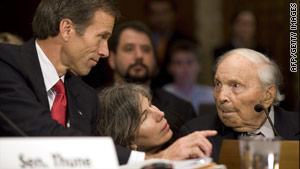
Sen. John Thune of South Dakota helps Frank Buckles, right, speak before a Senate subcommittee.

Washington (CNN) -- The last surviving U.S. veteran of World War I, former Cpl. Frank Buckles, turns 109 on Monday and is still hoping for a national memorial in Washington for his comrades.

Buckles is expected to deliver remarks during a quiet celebration Monday afternoon at his home in Charles Town, West Virginia.

But the old "Doughboy" -- as World War I American infantry troops were called -- has already been outspoken in recent years, urging congressional lawmakers to give federal recognition and a facelift to a run-down District of Columbia memorial in an overgrown, wooded area along the National Mall.

In December, at 108, Buckles testified on Capitol Hill as lawmakers considered whether to fund renovation and give the site "national" monument status. But rival legislation seeks the "national" designation for a 1920s-era memorial located in Kansas City, Missouri.

Congress has not yet decided on the legislation.

In 2008, the old soldier came to Washington and visited that 1930s-vintage District memorial. In his wheelchair, helped along by a military aide, he slowly crossed the cracks in the flagstone walkway, and saw the cracks in the marble gazebo.

Still sharp at only 107, he noted during that visit that the names engraved along the gazebo's marble walls are only of those who hailed from District of Columbia.

Buckles that day also met with then-President George W. Bush at the White House and Defense Secretary Robert Gates at the Pentagon.

Later in 2008, Buckles was the guest of honor at Veterans Day ceremonies at Arlington National Cemetery. He said he considers it his duty to represent his fellow soldiers.

 
Oldest WWI Vet : Frank Buckles

"I have to," he told CNN, "because I'm the last living member of Americans," who fought in what was called The Great War.

As a soldier in the U.S. Army, Buckles was an ambulance driver for U.S. forces in Europe, and once met commanding Gen. John Pershing, near whose grave the more recent Veterans Day ceremony was held.

Buckles was warmly greeted with standing applause by those in uniform and others who had gathered for the commemoration, but he said he did not think the fuss was about him.

"I can see what they're honoring: The veterans of World War I."

"Time has passed very quickly to me," he told CNN after a wreath-laying, "I've had a lot of activity in the last 90 years."

AddThis Social Bookmark Button
Email this post


US Marines End Role in Iraq  


RAMADI, Iraq - The U.S. Marine Corps wrapped nearly seven years in Iraq on Saturday, handing over duties to the Army and signaling the beginning of an accelerated withdrawal of American troops as the U.S. turns its focus away from the waning Iraqi war to a growing one in Afghanistan.

In Baghdad, meanwhile, Vice President Joe Biden held talks with Iraqi leaders amid growing tensions over plans to ban election candidates because of suspected links to Saddam Hussein's regime.

The White House worries the bans could raise questions over the fairness of the March 7 parliamentary elections, which are seen as an important step in the American pullout timetable.

The Marines formally handed over control of Sunni-dominated Anbar, Iraq's largest province, to the Army during a ceremony at a base in Ramadi - where some of the fiercest fighting of the war took place.

If all goes as planned, the last remaining Marines will be followed out by tens of thousands of soldiers in the coming months. President Barack Obama has ordered all but 50,000 troops out of the country by Aug. 31, 2010, with most to depart after the March 7 parliamentary election.

The remaining troops will leave by the end of 2011 under a U.S.-Iraqi security pact.

But concerns about the success of the election - and perhaps the loss of hard won security gains that the Marines helped cement - are on the rise because of a growing political dispute that could see more than 500 candidates blacklisted because of suspected ties to previous regime.

The changeover at Ramadi, west of Baghdad, leaves the U.S. Army's 1st Armored Division with responsibility over both Baghdad and Anbar, the vast desert province that stretches from western Baghdad to the borders of Syria, Jordan and Saudi Arabia.

The province was once the heart of the deadly Sunni insurgency that erupted after the U.S.-led invasion in 2003. In the battles for control of the cities of Fallujah and Ramadi, the Marines saw some of the most brutal and deadliest fighting of the war.

Violence began dropping off in the province in late 2006 when Sunni fighters - known as Awakening Councils - turned against al-Qaida and sided with the Marines to fight the insurgency.

As many as 25,000 Marines were in Iraq at the peak, mostly in Anbar province. The few thousand who remain - except for U.S. Embassy guards and advisers in Baghdad - are expected to ship out in a matter of weeks.

The upcoming parliamentary election is also considered an important step toward speeding the U.S. troop pullout. But plans to ban hundreds of candidates have raised deep concerns in Washington that the voting could widen rifts between the majority Shiites who gained power after Saddam's fall and Sunnis who are struggling to regain influence.

Biden, who arrived late Friday, had a full agenda of meetings with Iraqi leaders including Prime Minister Nouri al-Maliki, who has strongly supported the blacklist.

Some Sunni leaders have accused the Shiite-led government of using the ban as a political tool. But al-Maliki insists that Iraq must purge all ties to Saddam's Sunni-dominated regime. A vetting panel has put 512 names on the blacklist and more are expected.

AddThis Social Bookmark Button
Email this post


Marines to aid Haitian earthquake relief  

Some 5,700 US marines and soldiers are expected to join Haitian earthquake relief efforts this weekend. The UN says its peacekeeping force should be in command. The US says no.

Washington ---
The marines are about to hit the shores of Port-au-Prince – an arrival that would almost certainly send shivers up spines anywhere else in Latin America.

But amid the Haitian earthquake relief effort – in a country that has no military of its own and has hosted an international peacekeeping force since 2004 – the arrival is unlikely to cause many ripples among locals.

Yet the dispatch of some 2,200 marines – as well as 3,500 soldiers from the 82nd Airborne Division – is raising some command and assignment questions.

When the troops arrive, perhaps this weekend, who will be in charge, given that the Haitian government is almost disintegrated and the 9,000-strong UN peacekeeping force, MINUSTAH, is dealing with its own losses?

Will the 5,500 US military personnel be part of an international, or an American, security effort?

Who's the boss?

“It’s fully desirable that all these forces should be coordinated with the UN MINUSTAH commander there,” UN Secretary General Ban Ki-moon said Thursday.

US officials, on the other hand, say that while the US may “coordinate” with the peacekeeping operation’s leadership, US troops will be under American command.

“We’ll be under US command supporting a UN mission on behalf of the Haitian government and the Haitian people,” said State Department spokesman Philip Crowley, when asked Thursday to clarify the command structure for what is expected to be a three-month deployment of US forces.

Learning from the tsunami

The command question may cause some initial confusion, but it is likely to be quickly ironed out – especially given the recent experience the US has in dispatching the military to disaster zones, say US security and international relief experts.

“We sent 8,000 marines to Indonesia after the tsunami, and that intervention stands out as one of the best examples of use of the US military in a disaster,” says Lawrence Korb, a former assistant secretary of defense who is now an analyst at the Center for American Progress in Washington.

Not only did the Marines accomplish significant humanitarian objectives, Mr. Korb notes, but America’s image in Indonesia – the world’s largest Muslim country – shot up as a result. “The use of the military in this way really undermines the Al Qaeda narrative,” he says.
Haiti: a country without a government

The Haiti case is different, however, in part because the Haitian government is so weak, and in some estimations practically nonexistent, after the earthquake.

President René Préval is alive, but the Parliament and several ministry buildings collapsed, taking the lives of as-yet uncertain numbers of legislators and government officials.

The US says it is coordinating with the Haitian government – by which it appears to mean a little-seen President Préval – but acknowledges that in the short-term there will be little government to deal with.

“There’s no question that the Haitian Government is challenged,” the State Department’s Mr. Crowley says. “They have received a very serious blow.” But he adds that the US objective is “not only to provide lifesaving support to the Haitian people but to rebuild the capacity of the Haitian Government.”
Help wanted, calling Cuba?

The US needs to remember that it is part of an international effort, something Korb says the US sometimes forgets. In the case of Haiti, “We’ll be the first among equals, because of our size and proximity and our capabilities,” he says, “but we shouldn’t limit our approach to just what we can do.”

In that vein, Korb offers a politically daring proposition: The US should consider tapping the expertise of neighboring Cuba to help address Haiti’s needs.

“We should stop and think that Cuba right next door has some of the best doctors in the world,” he says. “We should see about flying them in.”

At the same time, the US must be careful not to run roughshod over historical sensitivities in the region about US military interventions.

“We’re not taking over Haiti," said Crowley. "We are helping to stabilize Haiti. We’re helping to provide them lifesaving support and material, and we’re going to be there over the long term to help Haiti rebuild.”


AddThis Social Bookmark Button
Email this post


Haiti Aid Delayed  


WASHINGTON --- The Pentagon is mobilizing a massive relief effort to help Haiti earthquake victims, but there are worries that the response will still take days to be in place.

The military’s efforts are at the front end of what President Obama said Thursday would be a $100 million U.S. commitment to Haitian relief.

But it is taking time to get there. The aircraft carrier USS Carl Vinson was expected to arrive Thursday afternoon but now will not be there until today. The USNS Comfort, a hospital ship, hasn’t left the port of Baltimore yet because it still needs to collect supplies and personnel.

While the assessment teams are still conducting their review of the need in Haiti, mostly in Port-au-Prince, near the epicenter of the magnitude 7.0 earthquake, there is a clear need for medical assistance.

The aircraft carrier arriving today has three operating rooms, several dozen hospital beds and can produce fresh water. The Bataan amphibious ship also possesses some medical assets and is being outfitted with more. But it is the Comfort hospital ship, with its 250 hospital beds and 12 operating rooms, that would appear to meet the most pressing need in Haiti.

A week for hospital ship to get there

Pentagon officials say that ship, one of the Navy’s two hospital ships, won’t leave Baltimore until this weekend and not arrive until sometime at the end of next week.

“It’s a slow moving vessel, it’s an older vessel, so it will take about a week to get down there once it gets all crewed up,” said Bryan Whitman, a Pentagon spokesman.

Ground troops are also being sent, including a brigade of about 3,500 Soldiers from the 82nd Airborne Division, Fort Bragg, N.C., and about 2,000 Marines from the 22nd Marine Expeditionary Unit in Camp Lejeune, N.C. The mission of the ground forces remains unclear, as the relief effort unfolds and government officials wait to see if any civil unrest would require an American ground presence.

Pentagon officials say the Army unit will arrive in Haiti by the end of the week. The Marines, who will arrive on the Bataan Amphibious Ready Group ships, will wait offshore and only go into Haiti depending on what occurs.

Obama: U.S. moving 'as quickly as possible'

“Even as we move as quickly as possible, it will take hours, and in many cases days, to get all of our people and resources on the ground,” Obama said at a news conference at the White House Thursday, his second meeting with the press about Haiti.

Roads remain impassable, the main port is “badly damaged,” and poor communications pose major challenges, he said.

“None of this will seem quick enough if you have a loved one who’s trapped, if you’re sleeping on the streets, if you can’t feed your children,” Obama said. “But it’s important that everybody in Haiti understand, at this very moment, one of the largest relief efforts in our recent history is moving towards Haiti.”

The U.S. will likely be the largest contributor to relief, and military officials say it takes time to assess the need and move in those supplies and assets that are most needed. But the enormity of the effort lends itself to feeding a perception that the military bureaucracy gets in the way.

Frustration at logistical challenge

Pentagon officials themselves seemed to express frustration at the logistical challenge they were confronting. Gen. Douglas Fraser, head of U.S. Southern Command, briefing reporters Wednesday, said the initial assessment team would “finally” arrive later that afternoon.

Fraser, who is new at Southern Command but now finds himself at the forefront of the military’s relief effort, is expected to update reporters on the situation in Haiti later Thursday.

Meanwhile, Pentagon officials disagree with any contention that the U.S. military is moving too slowly.

“I just don’t subscribe to that premise,” said Whitman. “I think the U.S. military has been very forward leaning on this and in terms of moving assets and anticipating requirements.”

Other officials point out that it took the hospital ship Comfort five days to mobilize and get underway after Hurricane Katrina. For the Haiti earthquake, they say, it's taking just half that long.

AddThis Social Bookmark Button
Email this post


New device tracks service records  

A newly installed electronic tracking device in Camp Pendleton Service Record Books is expected to save the base nearly $1.5 million and 54,000 man-hours annually.

The tracking system, implemented last October, now manages more than 38,000 Service Record Books belonging to Camp Pendleton service members.

“This user-friendly tool (has been) long overdue,” said Chief Warrant Officer 2 Sandy Gonzalez, officer in charge, Installation Personnel Administration Center, Marine Corps Base Camp Pendleton. “Since inception, this tool has optimized productivity and improved operational efficiencies. No longer will there be a need to pull and look at every single record to make sure they are there,” she said.

Service Record Book accountability that normally took weeks to establish, could now only take days.

Camp Pendleton is the second and largest installation to utilize the electronic tracking system after Marine Corps Base Hawaii.

“Hawaii manages about 8,000 service records, and the tracking system has enabled them to vastly increase productivity and accuracy,” said Gonzalez. “That equates to huge savings in man hours.”

All service members require a service record as it maintains a history of individual Marines. Handheld scanners and tracking pads identify the paper-thin tracking tags inserted in each SRB.

“If a file has been misplaced, you can locate it quickly with a sweep of the Handheld Tracker,” said Gonzalez.

Personnel administration centers throughout the Corps are expected to adopt the new system as testing continues on Camp Pendleton.


AddThis Social Bookmark Button
Email this post


World War II Navajo Code Talkers save lives with heritage  


Six Marines are credited with saving the lives of countless comrades and securing an American victory during the World War II Battle of Iwo Jima. These six, part of 29 original Navajo code talkers, decoded more than 800 coded messages during the first 48 hours of the battle.

The Inspiration:

Early in 1942, Philip Johnson, the child of missionaries on a Navajo reservation, a World War I veteran and a fluent speaker of Navajo, met with Maj. Gen. Clayton B. Vogel, the commanding general of Amphibious Corps, Pacific Fleet, to pitch the idea of developing an unbreakable code using the Navajo language for use during World War II, according to a report on the subject, available on the Central Intelligence Agency’s Web site.

Johnson pointed out the language, which is unwritten and contains variations in syntax, dialect and tonal qualities, would be indecipherable to someone who didn’t know the language.

Johnson also showed Vogel it was possible to send and decode a coded message in about 20 seconds, whereas the then current method of sending and decoding took about 30 minutes. Vogel went for it.

The First Steps:

The 29 Navajos recruited as the initial code talkers arrived at Camp Elliot, located near San Diego, after recruit training to put together a new code. The code was made more complex with the inclusion of a word substitution system, according to the Web site.

“For us, everything is memory. It’s part of our heritage,” said Carl Gorman, one of the original 29 code talkers, when asked why Navajos were able to memorize the code as quickly as they did, as stated in Marine Administrative Message 0634/09, which recognizes November as National Native American Heritage Month. “We have no written language. Our songs, our prayers, our stories - they’re all handed down from grandfather to children and we listen, we hear, we learn to remember everything.”

The Code:

Once each line of code was translated into English, the Marines pieced together the whole message using only the first letter of each of the translated words. To spell “Army,” a code talker might send “wol-la-chee (ant) gah (rabbit) na-as-tso-si (mouse) tsah-as-zih (yucca),” according to the Navajo code talker’s dictionary, available on www.history.navy.mil.

Each letter had several words associated with it. “A” was represented by “wol-la-chee (ant),” “be-la-sana (apple)” and “tse-nill (axe).” There was also a specialized list of words to represent common military terms, as listed in the dictionary. For example, the code word for “battleship” is “lo-tso,” literally translated as whale.

The dictionary, which originally contained 211 words, included 411 by the war end, according to the CIA Web site.

The Impact:

At first, some military leaders were skeptical about the new system. According to the CIA’s report, the code talkers were tested before being trusted with combat related messages. They proved themselves by sending, receiving and decoding the messages in record time and without error.

“Were it not for the Navajos, the Marines would never have taken Iwo Jima,” said then Maj. Howard Connor, the signal officer for 5th Marine Division at the Battle of Iwo Jima, according to www.navajo.org. Navajo code talkers were a key component of many of the major battles in the Pacific, including Guadalcanal, Tarawa and Peleliu.

The Recognition:

The world wouldn’t know the part Navajo code talkers played until 1968, when the code was declassified. In 1982, former President Ronald Reagan dubbed Aug. 14 “Navajo Code Talkers Day.”

Their story and the contributions of Native Americans across the nation are also remembered during each National Native American Heritage Month.

“This month, we celebrate the ancestry and time honored traditions of American Indians and Alaska Natives in North America. They have guided our land stewardship policies, added immeasurably to our cultural heritage and demonstrated courage in the face of adversity,” said President Barack Obama in a proclamation officially naming this month as National Native American Heritage Month 2009.

The Legacy Upheld:

Today, there are 2,409 Native Americans serving as active duty Marines and 1,508 Native Americans serving in the Marine Corps Reserve, according to Headquarters Marine Corps. So far, 5,509 active duty and reserve Native American Marines have served in Operations Iraqi Freedom and Enduring Freedom.

AddThis Social Bookmark Button
Email this post


Report Finds 75 Percent of Young Americans Unfit For Military  


It is not a short term problem because high unemployment rates are causing many qualified people to join the military. But retired generals and admirals say if the problem continues, national security could be in jeopardy when the economy improves.

Staff Sgt. Terrence Pugh's isn't fighting in a war zone. But on this college campus, his mission is anything but easy. Pugh is looking for new Army recruits. He says many people consider the military when they have no other options.

"Most people are not really interested in joining any branch of service really until life gets them in a bind," he said.

Vernika Givens is a single mom and unemployed. The Army offered Givens and her daughter a future.
"Medical benefits, a steady paycheck. I can get college money and I can save some money for her when she gets older," Givens said.

Givens is one of only a small group of Americans who qualify for the military.
 

The Army says seven out of 10 people who apply cannot pass a reading and math test.
A report released by Mission Readiness, an organization of retired military leaders, finds 75 percent of young Americans between 17 and 24 are unfit for the military.

The reasons: they did not graduate from high school, have a criminal background or are physically overweight and out of shape.

Mission Readiness says the military is currently meeting if not exceeding its recruitment goals largely because of the economic downturn. But many retired generals fear that there may be a shortage of qualified recruits when the economy improves.

"Our national security in the year 2030 is absolutely dependent on what's happening in pre-kindergarten today," Retired Navy Rear Admiral Jamie Barnett said.


Barnett says research shows children enrolled in a quality pre-kindergarten program raises their high school graduation rate by 44 percent.

"Those are the most sensitive years of their life, the years when you can really get them socially, emotionally, physically, any skill you want with them to make them a child who can succeed," Ricky Gleen said.

Gleen teaches at an early childhood development school called Centro Nia in Washington. He says students drop out of school and get in trouble with the law because they lack problem solving skills and self-esteem.

The Mission Readiness report finds students who do not get a quality early childhood education are 70 percent more likely to be arrested for a violent crime by the time they turn 18.

Gleen says every activity here teaches skills to help students make better life choices.

"They have a sense of self. They have a sense they can make it. They have a sense that they can solve problems," he said.

Gleen's school also teaches students the value of education, how to eat right and exercise.

The goal is that they can continue to apply what they have learned here when they get older.

Some of them may even decide to join a high school Junior Reserve Officers Training Corps class like this one.

"I really like the sense of team and leadership and friendship," Jamie Whitaker said.

Whitaker has good grades, is on a swim team and plans to join the U.S. Air Force.

The military wants to see more possible recruits like Whitaker. And the retired military leaders with Mission Readiness are pushing Congress for one billion dollars a year for up to 10 years to fund more early childhood development programs.

"It is a long term investment," Arne Duncan said. "It is not something that pays off overnight. It is absolutely the right investment we can make."

Duncan is the Secretary of Education. He adds, if nothing is done, America's national security will be at risk.


AddThis Social Bookmark Button
Email this post


VMM-266 honored as tiltrotor squadron of year  


The Fighting Griffins of Marine Medium Tiltrotor Squadron 266 have found themselves on top as they were recently recognized as the Marine Corps Aviation Association’s 2009 tiltrotor squadron of the year.

The Fred McCorkle Tiltrotor Squadron of the Year Award, which was presented to the squadron in October during the Marine Corps Aviation Association’s annual symposium at the Grand Sierra Resort in Reno, Nev., spotlights their accomplishments and meritorious service in support of II Marine Expeditionary Force from May 2008 through April 2009.

“The Fighting Griffins of VMM-266 set the standard for others to emulate by providing assault support to both the Fleet Marine Force while in (contiguous United States) and to Multi-National Coalition Forces while deployed to Iraq,” as stated in the award citation.

“From flawless execution of pre-deployment training, evaluation and certification during Desert Talon, to the successful execution of sustained combat operations in Al Asad, Iraq, VMM-266 raised the bar for Marine aviation.”

During their deployment in support of Operation Iraqi Freedom, VMM-266 successfully produced the highest number of MV-22B flight hours during the annual reporting period.

During Operation Iraqi Freedom, this effort resulted in the safe completion of more than 2,366 sorties, an estimated 3,550 mishap-free flight hours while safely transporting an approximate 17,599 assault support request passengers and more than 553,661 pounds of cargo.

According to the citation, the squadron’s extensive contributions significantly enhanced the war fighting capability of the individual Marine and the Marine air ground task force, and made tiltrotor aviation a fully integrated reality for the United States Marine Corps.

The squadron was the third and final Osprey squadron to deploy to Iraq. After being there for nearly six months, VMM-266 returned to New River with all 12 of the aircraft used for the three deployments.

“It is a testament to the dedication and hard work of the Marines that call themselves the Fighting Griffins,” said Lt. Col. Romin Dasmalchi, VMM-266 commanding officer. “They are the ones responsible for building this squadron up and making it what it is today.

“It is their hard work and determination to get the job done that has transformed this squadron into a top-notch support squadron,” he said.

AddThis Social Bookmark Button
Email this post


In life they honored their country, in death their country honors them  

Arlington — All was quiet, there was no laughter in the air, not even the children spoke. Everyone knew this was a sacred and somber place. It is where family and friends come to see their loved ones who died while serving this country.

The day began with the sun glinting off of the rolling hills of marble, flowing across the land as far as the eye could see. Hundreds of thousands of fathers, brothers, sisters and mothers lay here, all of whom gave the ultimate sacrifice fighting with honor, courage and the utmost commitment for their country in conflicts from as far back as the Civil War.

It was a bitter cold day, but the sun warmed up the faces that reflected off of the rows of white headstones in Arlington National Cemetery. They stood as symbols of service and sacrifice, but this time they did not stand alone.

On Dec. 11, 55 Marines with Marine Corps Combat Service Support School, Camp Johnson, N.C., embarked on a seven-hour trip that would take them to Arlington, Va., the final resting place for more than 300,000 service members, civilians and presidents.

The Marines came to pay their respects to service members who came before them and those who made the ultimate sacrifice. For many Marines, this was the first time visiting the cemetery.

“It’s a new experience for me,” said Pfc. Dennise Alava, a student with MCCSSS. “I came to pay my respects and show my gratitude for those who fought for this country.”

What started out with a few dozen friends laying 5,000 wreaths in a corner of Arlington in 1992, blossomed to thousands of people coming to lay wreaths every second Saturday of December from places as far as California, Washington and Florida. The amount of wreaths placed on the headstones now totals more than 15,000.

Although the numbers are staggering, each wreath is placed with tender care and thought.

Wreath-layers were asked to take one wreath and then take the time to select one hero to honor with a wreath and if they have a religious preference, a prayer.

Throughout the cemetery Marines took time out of the day to stand, kneel or sit by a grave and offer a prayer, talk or shed a few tears for someone they never knew.

The Marines placed their wreaths covering an entire section of the cemetery, however, they weren’t quite finished, they still had wreaths to lay at one more section of Arlington. A section often called ‘the saddest acre in America.’

The United Service Organization sponsored 1,000 extra wreaths for section 60, the final resting place for fallen service members from the wars in Iraq and Afghanistan.

Alongside the Marines, families of the fallen placed their wreaths on the graves of their loved ones.

One of the family members present was Ruth Stonesifer, who lost her son to a Black Hawk crash during the first night of Operation Enduring Freedom and is now a member of the American Gold Star Mothers.

“Sometimes during moments of panic we fear that our children will be forgotten,” said Stonesifer. “Seeing a group of strangers paying their respects to their graves gives us hope that they will not be forgotten.”

Although each wreath was a simple one made from balsam fir trees with a bright red bow, they had a great impact on people attending. Throughout the cemetery mothers, fathers, friends and siblings cried as they reached out to touch the headstone of a deceased loved one.

Each headstone bears the name, rank, military branch, birth date and the day they passed away. Most service members were in their early to mid-20s, who never got to experience a full life, raise a family or come back to see their loved ones.

“The goal for Wreaths Across America is to remember the fallen, honor those who serve, and teach our children the value of freedom,” said Morrill Worcester, founder of Wreaths Across America. “These are families here, they’re not just stones, they’re not graves, this is our history.”


AddThis Social Bookmark Button
Email this post


Copyright © 2010 | The Military Post | All Rights Reserved